From discovery to a considered choice
How to Choose a Baby Name
Choose a baby name with a clear family workflow: set priorities, check origins, try the complete name, record questions and compare a practical shortlist.
Updated 2026-11-02.
Begin with the decision your family actually needs to make
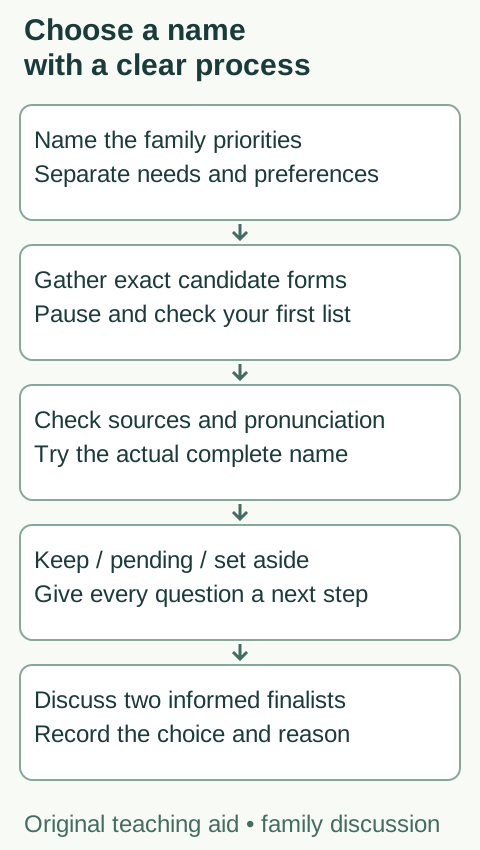
Choosing a baby name becomes easier when you separate finding possibilities from choosing among them. During discovery you can be curious and keep several ideas. During the decision you need a smaller set that you can discuss fairly. Moving between those two stages without noticing can leave you searching indefinitely: every promising name becomes a reason to open another list instead of a candidate to examine.
Write down what matters before browsing. You might want to honor a particular relative, use a name comfortably in two languages, retain an exact family spelling, or enjoy a certain sound with the complete name. Then distinguish a requirement from a preference. “We intend to use this family name” and “we usually like short names” have different consequences. A preference can guide discovery without disqualifying every name outside its pattern.
Ask each person involved to name one or two priorities in ordinary language. If one person wants a familiar pronunciation and the other wants a meaningful family connection, record both rather than assuming the disagreement is simply about taste. You can look for candidates that satisfy both, or decide together which tradeoff you can accept. The number of priorities is a practical aid, not a scientifically established optimum.
For example, “easy for our relatives to say” needs a language and a use case. It may mean grandparents can use the intended form comfortably, or that a child can explain it in a particular school setting. It does not mean a name must be familiar to everyone, use only ASCII letters, or fit a fixed first-name, middle-name and surname pattern. Describe your own intended use, then check it.
Build a candidate list, then pause the search
Collect names from sources that serve your priorities: a family record, a language-specific reference, a story you value, or a catalogue filtered by a feature you actually want. Keep the exact spelling and the source beside the idea. If a name has several language forms, record the form you intend rather than treating every related spelling as interchangeable. An attractive list title is a discovery aid; it does not verify a name’s history.
Choose a stopping point for the first search. It can be a short session, a particular set of family records, or enough possibilities to fill a five-candidate sheet. Five is the capacity of our printable record, not a rule that every family needs precisely five finalists. Add another copy if your list is larger. The useful step is to stop gathering temporarily so that you can learn something about the candidates already on the page.
Avoid testing only your favorite while leaving the alternatives vague. A candidate with a beautiful story but an unchecked pronunciation is not directly comparable with a candidate whose full name you have practiced. Give each name the same initial checks. If a promising option is not ready to compare, mark the unanswered question and return to it; do not count a blank as a negative result.
You can keep a separate “later” list for appealing names that do not fit the current decision. This reduces the temptation to reopen every possibility in each conversation. If a new candidate clearly addresses a priority that the current list misses, bring it in with its source and intended form. Otherwise, complete the first comparison before restarting discovery. You are choosing a name you can explain and use, rather than proving that no better name exists anywhere.
Check meaning, origin and popularity as different claims
A useful factual note asks a narrow question. What does the source say about this exact spelling? Is it a short form, a related language form, or a name with more than one proposed origin? Which claim is certain, and which is described as uncertain? Keep a root-word translation distinct from later symbolism and from your family’s reason for liking the name. A name can matter deeply without having the poetic meaning printed on a general list.
Liam is a practical example: Behind the Name describes it as an Irish short form of William. William’s inherited Germanic elements are another level of that history. Calling Liam simply “Germanic” can hide the Irish formation; saying it literally guarantees a protective personality adds a claim the word history cannot establish. The Liam and Noah comparison shows how to record those distinctions for two actual candidates.
If familiarity matters, check usage separately. Write the location, birth year, recorded category and exact spelling of any count or rank you use. A historical US national count does not tell you the names in a future classroom, and a package’s publication date is not automatically the birth year of its data. Similar spellings may be separate rows. The SSA reading guide explains how to avoid those comparison mistakes.
Treat an important unresolved claim as a question to investigate. You may want a language speaker’s help with pronunciation, a more specific source for a family form, or the relevant official source for registration requirements. The workflow on this page does not establish legal acceptance or religious approval. Use the authority appropriate to the question, and keep the answer with the name so that a later discussion does not turn an assumption into a fact.
Try the complete name in the languages and situations you intend
Write the complete name in its intended order and spelling. Preserve accents, apostrophes, hyphens and capitalization where they belong. W3C’s discussion of personal names explains why naming systems vary and why a fixed first/middle/last division does not fit everyone. Its scope is names in forms and data systems; here the practical lesson is to leave room for your family’s real name structure when making a record.
Say the name as an introduction, as a natural call across a room, and in the forms your family expects to use. Listen at the boundaries between components. A pattern that sounds clear when each part is said slowly may feel different at a normal pace. Try each language form separately if your family intends more than one pronunciation. A different syllable count across languages is not by itself a defect.
Ask a listener to repeat the intended pronunciation if that person is willing. A mishearing can identify a particular sound to explain; it is not a vote against the name. Write a plain-language stress note or make a short recording for relatives. The family pronunciation guide gives a fuller method for making that note without presenting one language’s version as universal.
Check initials if your family uses them and if they matter in your setting. Consider the actual order of name parts rather than inventing a middle name merely to fit a template. An unexpected initial pattern may be a reason to try another combination, or it may be irrelevant to your everyday use. The whole-name checklist provides a separate place to record these observations.
Ask for useful feedback, then record the reason
| Question to ask | What to record | What it cannot settle |
|---|---|---|
| How would you say this in the language you use? | Specific sound or stress, and the intended version | A universally correct pronunciation in every language |
| Can you hear the boundary in our complete name? | Which combination was clear or needed repetition | Whether every stranger will react the same way |
| Which of our priorities does this candidate meet? | A named priority and an explained observation | A guaranteed best name or future personality |
Explain the purpose before sharing a list. If you need help with pronunciation, ask for that rather than a general vote on attractiveness. If you want to understand a family record, ask about the actual spelling, person and context. Broad requests for opinions can produce many incompatible reactions without supplying the information you need. Decide how much outside feedback is useful to your family.
When someone dislikes a name, ask whether the concern is a factual question, a sound observation or a personal association. Record it in that category. “I associate this with someone I knew” can matter to a family relationship, but it is different from evidence about linguistic origin. “I cannot hear the boundary” suggests a sound check. You do not have to convert every opinion into a requirement.
Keep feedback bounded. A poll can help organize responses from people you choose to involve, but the most votes do not establish etymology, legal acceptability or an objectively superior name. Agree beforehand how you will use the responses. This helps avoid the situation where each person seeks more voters until the result favors a preferred candidate.
Move from several possibilities to a decision you can explain
Review the list using three statuses: keep, pending a check, or set aside. A pending name needs a specific next action, such as checking a source entry or trying the full pronunciation with a relative. A name set aside should have a short reason, preferably linked to your priorities. Keeping that reason reduces repeated debates and makes it easier to reconsider if a fact later changes.
The five-candidate printable list is useful at this stage. It keeps complete names, pronunciation, evidence and next actions together. Once two candidates remain and the facts you care about are reasonably clear, move to the two-finalist worksheet. That resource is for a focused shared comparison; it serves a different purpose from collecting several possibilities.
Agree on the next discussion rather than leaving the decision open indefinitely. Each person can explain which candidate best meets a priority and which compromise they accept. You may prefer a name that is familiar, distinctive, brief, long or connected with your family; none of those preferences requires exaggerating its rarity or inventing a literal meaning. An honest explanation is more durable than a persuasive but unsupported story.
Before the final choice, recheck the intended written form, pronunciation, actual complete-name combination and any applicable registration requirement through the proper local source. Keep your factual note and your family reason. The decision cannot predict a child’s character or control every future nickname, but it can reflect a considered choice that your family understands.
Try five practical checks
Decision check 1: A name has an attractive meaning on a general list. Is the history checked?
Not yet. Find the entry for the exact intended form, retain any uncertainty, and separate root-word meaning from symbolism and your family reason.
Decision check 2: Do all families need exactly five candidates and three name parts?
No. Five is our printable layout capacity. Naming systems and family needs vary; record the complete intended name and add copies when useful.
Decision check 3: One option has a verified pronunciation; the other has a blank. Should the blank score zero?
No. Mark the relevant question as pending and check the intended language version before comparing the options on that priority.
Decision check 4: A relative dislikes the sound. Does that settle the name’s origin?
No. A sound preference, a personal association and a linguistic claim are different kinds of information. Ask the source appropriate to the question.
Decision check 5: Two candidates remain, but the family disagrees about an honor connection. Is another ranking list the next step?
Not necessarily. Discuss which family priority matters and the compromise each person accepts. Usage data does not settle an honor-name preference.
Keep a useful record
Sources and limits
- W3C: Personal names around the world — Explains naming-format and character diversity in forms and data systems. It does not validate this family decision workflow or establish legal acceptance.
- Behind the Name: Liam — Supports the Irish short-form connection with William, used as a factual-note example.
- Behind the Name: William — Supports the older Germanic elements behind William; not a prediction about personality.
Family examples, diagrams and worksheet prompts are original teaching material. Name history, dated usage evidence and personal preference answer different questions. The workflow does not establish a universally best name, legal acceptance or a prediction about a child.