Practical guide
Choosing Between Two Baby Names: A Decision Worksheet
Write the two complete candidates, separate factual checks from preferences, and fill one record per decision-maker. Use clear criteria, ten importance points and a consistent 1–3 scale to see where your reasons differ. Two invented worked records, a sensitivity example and a downloadable worksheet support a family discussion without letting a total make the decision.
Write exactly which two names you are comparing
If you are down to two baby names, write both complete candidates before collecting more suggestions. Include the actual spelling, intended name order and any middle or family-name parts you plan to use. A favorite everyday short form is a separate field, not a silent replacement for the full candidate.
Keep the same candidates throughout the first comparison. If Name A has one middle-name arrangement on your sheet and another on someone else’s, you are not evaluating the same choice. Label different intended language or pronunciation versions instead of blending them into one assumed universal form.
The W3C guide to personal names explains why names do not all follow a first-middle-last pattern. Retain your family’s complete form and spelling. The worksheet uses “Candidate A” and “Candidate B” to avoid making that structural assumption.
For written initials and grouping questions, complete the full-name and initials check first. Then return to this sheet with the complete candidates you intend to compare.
Keep factual checks and essential conditions outside the score
Make three short lists: facts to verify, conditions you consider essential, and preferences you want to compare. A claimed origin, local registration requirement or specific popularity count belongs in the factual list. “We enjoy the sound” belongs in the preference list.
Write who or what can resolve each factual question. Keep a language or cultural question with a suitable source or knowledgeable speaker. For an official requirement, consult the relevant authority’s current instructions. A family vote cannot verify the claim, and an unresolved claim is not automatically a negative score.
Discuss an essential condition openly before rating. It might be a complete written form both decision-makers can accept, or retaining a particular family-name part. Do not hide it as a low-weight row that can be outweighed by unrelated features. A candidate that remains unresolved on an essential condition is not cleared by a high total.
If familiarity matters, define the place, period and level of familiarity you actually prefer before looking for a number. “Rare” and “popular” do not have a useful meaning without that context. Record the relevant location, year and source beside any popularity figure you use.
Choose a few criteria with a consistent direction
Each person should choose a small set of relevant preferences. The five-row examples below are an original starting set, not a required list: family connection, comfort saying the full name, personal style, the written form and preferred familiarity. Replace a row that does not matter to you.
Write the preference clearly enough that a high rating always means a closer fit. “Familiarity level we prefer” can mean familiar for one person or less familiar for another; state the intended direction. Do not use “rarity” on one sheet as a positive and on another as a negative without explaining the difference.
Avoid counting the same feature repeatedly. If sound, rhythm and flow all refer to the same observation, combine them or explain the different jobs. Repeating similar rows gives that preference extra influence while making the worksheet look more balanced than it is.
The ASQ decision-matrix method recommends refining criteria, assigning relative weights and keeping rating scales consistent. Its general method can organize a comparison; it does not establish that baby names have an objectively measurable compatibility score.
Use a consistent 1–3 scale on each sheet: 1 means a weak fit to the stated preference, 2 a partial fit, and 3 a strong fit. These are personal judgments based on the complete candidate you tested. Leave an unknown factual question in the separate check list rather than entering a zero or pretending it has been answered.
Fill the two preference records independently
Give each decision-maker a separate copy of the worksheet. Each allocates ten importance points across their chosen criteria, then rates both candidates against those criteria. Keep their reasons beside the numbers. Ten is simply this worksheet’s common weight budget, not a scientific naming threshold.
A criterion can receive zero importance points if you have deliberately left it out of your preference total. Keep essential conditions outside that allocation. With ten points and a 1–3 scale, a complete total ranges from 10 to 30. The total is not a percentage, and 30 does not mean a perfect name.
Multiply each rating by its criterion’s weight, then add the weighted contributions for each candidate. Do not use weight and rating interchangeably: importance is about the criterion; fit is about the candidate. Keep the same weights for A and B within one person’s sheet.
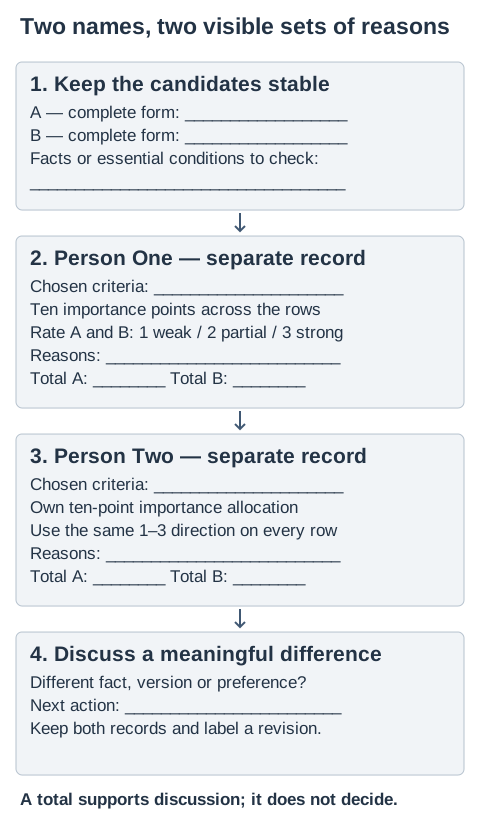
Complete the first pass without copying the other person’s scores. You can revise your priorities later; keep the first sheets to make changes clear. Afterward, compare the reasons and definitions before discussing which total is larger.
Read two invented records before using your own
The examples use unnamed Candidates A and B. All weights, ratings and observations are invented to explain the worksheet. They are not data about real families or a ranking of particular names. A high rating means closer fit to that person’s stated preference.
| Criterion | Weight | A rating | A weighted | B rating | B weighted |
|---|---|---|---|---|---|
| Family connection we want | 3 | 3 | 9 | 2 | 6 |
| Full-name comfort in ordinary speech | 3 | 3 | 9 | 2 | 6 |
| Style we personally enjoy | 2 | 2 | 4 | 3 | 6 |
| Written form we want to use | 1 | 2 | 2 | 3 | 3 |
| Familiarity level we prefer | 1 | 2 | 2 | 3 | 3 |
| Totals | 10 | — | 26 | — | 24 |
Person One’s A total is 26 and B total is 24. Family connection contributes 9 versus 6; full-name comfort also contributes 9 versus 6. The other rows favor B. The useful explanation is where the preference comes from, rather than “A wins by two.”
| Criterion | Weight | A rating | A weighted | B rating | B weighted |
|---|---|---|---|---|---|
| Family connection we want | 1 | 2 | 2 | 3 | 3 |
| Full-name comfort in ordinary speech | 2 | 2 | 4 | 2 | 4 |
| Style we personally enjoy | 3 | 2 | 6 | 3 | 9 |
| Written form we want to use | 3 | 1 | 3 | 3 | 9 |
| Familiarity level we prefer | 1 | 2 | 2 | 2 | 2 |
| Totals | 10 | — | 17 | — | 27 |
Person Two’s A total is 17 and B total is 27. Their written-form row contributes 3 versus 9, and their style row contributes 6 versus 9. Their priorities and perceptions differ from Person One’s. A large difference on this scale still does not establish a measured outcome for the child.
Do not add the two sheets into a supposedly neutral family winner. A combined total can conceal a condition one person considers essential or a different candidate form they tested. Keep each sheet intact and discuss the reason for the disagreement.
For a quick sensitivity check, move one of Person One’s weight points from family connection to familiarity, keeping ratings unchanged. A becomes 26 − 3 + 2 = 25; B becomes 24 − 2 + 3 = 25. A small priority change removes the original lead. That is a reason to talk about priorities, not to keep editing weights until a favorite wins.
Discuss one meaningful difference and agree the next action
Start with a concrete question: “Which row means something different on our sheets?” One person might rate an intended spelling while the other rates a familiar alternative; one might value an association that the other did not know. Compare the actual candidates and reasons before treating the disagreement as incompatible tastes.
Use a simple discussion record: the row, each person’s observation, whether the difference is factual or a preference, and the next action. A factual difference may need a source check. A pronunciation concern may need the family’s intended spoken model. A taste difference can stay a taste difference without inventing a rule to settle it.
For example, write “We tested different everyday forms; we will say both complete candidates in the same introduction.” Or “Family connection matters more to one of us; we will explain what that connection means before changing the allocation.” These are original prompts, not guaranteed conflict-resolution techniques.
For the spoken comparison, use the surname rhythm guide without treating its reference patterns as penalties. If the intended model is unclear, use the pronunciation communication card. Those checks help describe the candidates; they do not override a family preference.
The next decision can be to choose a candidate, check one unresolved fact, test a changed complete form, or take more time within your actual administrative schedule. A tie does not require a random choice. External feedback is optional and should address a specific question rather than turn the decision into a public popularity contest.
Eight comparison cases with full explanations
These cases use the invented records above and this worksheet’s ten-point, 1–3 convention. Identify what the arithmetic establishes and what remains a family discussion before opening each explanation.
Case 1
Person One gives a criterion weight 3 and rates Name A as 2. What is its weighted contribution, and what does it mean?
Show answer and explanation for case 1
Six points: 3 multiplied by 2.
The weight says how important the chosen criterion is to this person; the rating says how well the candidate fits their defined preference. Six is an arithmetic contribution, not a measurement of the name’s quality or the child’s future.
Case 2
Person One’s original example totals are A = 26 and B = 24. Does the worksheet require choosing A?
Show answer and explanation for case 2
No. Inspect the criteria and discuss what the two-point difference represents.
The total depends on chosen weights and subjective ratings. ASQ explicitly treats relative scores as a basis for discussion, not an automatic selection rule. A required factual check, unresolved concern or another decision-maker’s preference remains visible outside the total.
Case 3
Person One moves one weight point from family connection to familiarity preference, keeping the ratings unchanged. What happens to the example totals?
Show answer and explanation for case 3
Both become 25.
Family connection changes from weight 3 to 2, removing 3 points from A and 2 from B. Familiarity changes from 1 to 2, adding 2 to A and 3 to B. Thus A is 26 − 3 + 2 = 25 and B is 24 − 2 + 3 = 25. A small priority change removes the original lead.
Case 4
One sheet uses high ratings for less correction effort; the other gives high ratings for more correction effort. Can their totals be read consistently?
Show answer and explanation for case 4
No. Define the preferred direction before comparing ratings.
A high rating must always mean a closer fit to the stated preference. Reword the criterion, for example as “comfort with the written and spoken form we intend,” and state what 1, 2 and 3 mean. Do not label a family or language pronunciation defective to simplify the score.
Case 5
A claimed name meaning matters to the family, but its source has not been checked. Should the blank factual field be rated zero?
Show answer and explanation for case 5
Keep it unresolved and verify it separately.
Unknown is not the same as a poor fit. Zero is outside this worksheet’s 1–3 rating scale. Write the claim, the source or speaker needed and the next check. A score does not establish an etymology, registration rule or popularity count.
Case 6
Person One prefers A, while Person Two’s example favors B by 27 to 17. Should the two totals be averaged to settle the choice?
Show answer and explanation for case 6
Keep the two sheets separate and discuss the largest meaningful disagreement.
Averaging hides different priorities and ratings. In this invented example, Person Two gives substantial weight to the written form and rates A differently there. Ask what complete form each person tested and what matters to them. A combined total is not a consent rule.
Case 7
Both candidates receive identical ratings on every criterion for one person. Will moving weight points between those criteria create a real preference difference?
Show answer and explanation for case 7
No. With identical candidate ratings on each row, their totals remain equal.
Each row contributes the same weighted amount to A and B. Reweighting those equal pairs cannot create a difference. The useful next step is to explain an unrecorded preference, do a factual check or leave the decision open rather than invent scores to produce a winner.
Case 8
The full written candidate changes after the discussion, but its old ratings still refer to the previous middle-name arrangement. Is the old total ready to reuse?
Show answer and explanation for case 8
Recheck the changed complete form and label a new revision.
The comparison needs stable candidates. Keep the exact spelling, order, intended everyday form and language version beside the ratings. A different complete name can change what was tested. Revise the affected observations openly instead of silently changing a name while keeping its old score.
Download the worksheet and retain a clear revision
The two-person baby-name decision worksheet includes two complete-candidate records, factual and essential-condition lists, two blank five-row scoring sheets, a discussion log, the worked examples and all eight explained cases. You can use the blank sections on paper without entering a name into this website.
Candidate A — complete written and everyday forms:
Candidate B — complete written and everyday forms:
Intended language or pronunciation versions:
Unresolved facts and the source or person to check:
Essential conditions discussed separately:
Person One: criteria / ten importance points / A and B ratings / reasons:
Person Two: criteria / ten importance points / A and B ratings / reasons:
One meaningful difference and what explains it:
Agreed next action and any actual deadline:
Revision: what changed in the candidates or record?
Keep the original sheets if you revise a name, a criterion or a weight. Write the reason for the change, then update the affected observations. Quietly changing scores after seeing the totals makes the record less useful; openly reconsidering a preference is part of the discussion.
Use this worksheet after narrowing the list. If you still want to discover alternatives, the Olivia sound-and-style guide provides a different browsing task. The worksheet’s purpose is to clarify two real options and the reasons that matter to your family, leaving the final choice with the people making it.
Sources and further reading
- American Society for Quality: What Is a Decision Matrix?General criteria selection, relative weights, consistent rating direction, weighted totals and discussion of assumptions. This worksheet is an original family application, not an ASQ-validated baby-name test.
- W3C Internationalization: Personal names around the worldDiffering complete-name structures and orders, spelling and punctuation, and the distinction between a full written name and a form of address. No universal registration or personal pronunciation rule is inferred.