Practical guide
Short First Names with Long Surnames: Rhythm and Stress
A short first name can make a long written surname easier to handle, but letter count alone cannot tell you how the full name sounds. Compare spoken syllables, stress and the join between name parts. These 24 fictional pairings, four reference patterns and a manual stress exercise help you hear differences while keeping your family’s intended pronunciation intact.
Start with the spoken surname, not its letter count
For a long surname, shortlist names you like first, then say each complete combination. A one-syllable given name offers a brief opening; a two-syllable name can offer a different transition. Neither length is a universal solution. The same surname can sound different across languages or families, so begin with the pronunciation you intend to use.
Keep written length and spoken length separate. In the English reference used here, Schneider and Thompson each have two syllables; Harrington and Montgomery have three; Alexander and McAllister have four. A long spelling does not necessarily contain more spoken beats than a shorter one.
Merriam-Webster defines a syllable as a unit of spoken language built around a vowel sound or a syllabic consonant. Counting written vowels is therefore not a reliable method. Say the name, listen for the spoken units and check a pronunciation source when unsure. Dictionary divisions and ordinary speech need not align perfectly.
Write the surname exactly as the family uses it, including spaces, prefixes, apostrophes and hyphens. The W3C’s guidance on personal names explains why names do not universally fit a two-word given-name/family-name model. Use this guide’s two-component examples as sound comparisons, not instructions to simplify a complete name.
Hear where the strongest syllable falls
In speech, stress refers to emphasis that gives a sound, syllable or word relative prominence. Here, “primary” marks the main stressed syllable in a selected dictionary pronunciation; “secondary” marks an additional, less prominent stress. They are not judgments about a name’s quality.
Count positions from one within each component. Harrington’s selected reference has primary stress on position one; Montgomery’s has it on position two. Both have three syllables, but the location changes what you hear after the given name. This is why a rule such as “one short name plus one long name” misses part of the decision.
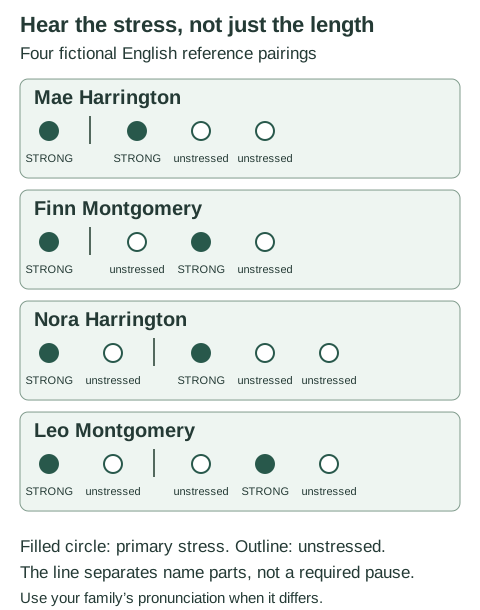
Two strong syllables near a join are not automatically awkward, and several unstressed syllables are not automatically elegant. Say the name in a normal voice rather than performing the diagram. In languages with different stress, tone or rhythm systems, use a pronunciation description suitable to that language instead of forcing this English reference model onto it.
Compare 24 fictional pairings in six small groups
All combinations below are invented examples, not identified real families or predictions of popularity. Each given name appears once. The syllable and stress columns use the first exact selected entry in the CMU Pronouncing Dictionary, an English speech dictionary maintained by the Carnegie Mellon University Speech Group. They describe that reference pronunciation, not every possible pronunciation of the spelling.
“Given: 1; surname: 2” means the first given-name syllable and the second surname syllable carry primary stress. Additional secondary stress is shown where present. The dictionary contains pronunciation variants for some entries, including Eva, Fernandez, Alexander and Thompson. Keep those variants distinct from the version your family uses.
| Example pairing | Reference syllable count | Primary stress positions, counted from 1 | Listen for |
|---|---|---|---|
| Mae Harrington | 1 + 3 = 4 syllables | Given: 1; surname: 1. | Compare a brief opening with an initially stressed surname. |
| Finn Montgomery | 1 + 3 = 4 syllables | Given: 1; surname: 2. | Notice the unstressed first syllable of the reference surname. |
| June Rodriguez | 1 + 3 = 4 syllables | Given: 1; surname: 2. | Hear the join before the surname’s main stress. |
| Jack Fernandez | 1 + 3 = 4 syllables | Given: 1; surname: 2. | Check the consonant-to-consonant join in your pronunciation. |
The first group isolates a brief opening. Check the transition into the surname rather than assuming all one-syllable names behave alike. Mae and Jack differ in their final sounds even though each has one reference syllable.
| Example pairing | Reference syllable count | Primary stress positions, counted from 1 | Listen for |
|---|---|---|---|
| Nora Harrington | 2 + 3 = 5 syllables | Given: 1; surname: 1. | Try an unstressed given-name ending before a strong surname opening. |
| Leo Montgomery | 2 + 3 = 5 syllables | Given: 1; surname: 2. | Compare the two initial unstressed syllables around the join. |
| Ada Rodriguez | 2 + 3 = 5 syllables | Given: 1; surname: 2. | Keep the intended vowel quality while comparing the full rhythm. |
| Theo Fernandez | 2 + 3 = 5 syllables | Given: 1; surname: 2. | Use the pronunciation your family intends, not a spelling-based guess. |
The second group lets an unstressed given-name ending meet the surname. Compare its pace with the first group, then try your actual candidates. Do not choose Nora solely because a formula prefers two syllables.
| Example pairing | Reference syllable count | Primary stress positions, counted from 1 | Listen for |
|---|---|---|---|
| Eva Alexander | 2 + 4 = 6 syllables | Given: 1; surname: 3. Surname secondary: 1. | Say the final and initial vowels at an ordinary pace. |
| Mia Ellington | 2 + 3 = 5 syllables | Given: 1; surname: 1. | Notice whether both name parts remain clear when joined. |
| Eli Anderson | 2 + 3 = 5 syllables | Given: 1; surname: 1. | Compare the complete form without forcing an extra pause. |
| Ava O'Sullivan | 2 + 4 = 6 syllables | Given: 1; surname: 2. | Keep the surname prefix intact and listen to the join. |
At a vowel join, listen for clarity without inserting an exaggerated pause. Eva’s initial vowel differs between dictionary variants; the table’s count and stress do not establish a single mandatory vowel. Alexander also has secondary stress on its first syllable in the selected entry.
| Example pairing | Reference syllable count | Primary stress positions, counted from 1 | Listen for |
|---|---|---|---|
| Rose Stevenson | 1 + 3 = 4 syllables | Given: 1; surname: 1. | Listen to the adjacent end and beginning sounds. |
| Max Schneider | 1 + 2 = 3 syllables | Given: 1; surname: 1. | Compare the consonant cluster without treating it as a fault. |
| Seth Thompson | 1 + 2 = 3 syllables | Given: 1; surname: 1. | Try the repeated boundary consonant in ordinary speech. |
| Luke McAllister | 1 + 4 = 5 syllables | Given: 1; surname: 2. | Preserve the surname spelling while saying the whole form. |
Consonant joins can require a little attention at an ordinary speaking pace. They are features to hear, not defects to eliminate. Keep pronunciation natural rather than repeatedly slowing it until every consonant becomes an isolated sound.
| Example pairing | Reference syllable count | Primary stress positions, counted from 1 | Listen for |
|---|---|---|---|
| Anna Anderson | 2 + 3 = 5 syllables | Given: 1; surname: 1. | Decide whether the repeated opening feels intentional to you. |
| Holly Hollingsworth | 2 + 3 = 5 syllables | Given: 1; surname: 1. Surname secondary: 3. | Listen to the repeated opening and the surname’s secondary stress. |
| Mira Montgomery | 2 + 3 = 5 syllables | Given: 1; surname: 2. | Compare the repeated initial consonant with the changing vowels. |
| Nina Nicholson | 2 + 3 = 5 syllables | Given: 1; surname: 1. | Try the alliteration in an ordinary introduction. |
Repeated initial sounds can be a deliberate preference. Mira Montgomery and Nina Nicholson repeat an initial consonant, but their opening vowels differ in this reference. Holly Hollingsworth also illustrates secondary surname stress on position three; do not relabel that syllable as wholly unstressed.
| Example pairing | Reference syllable count | Primary stress positions, counted from 1 | Listen for |
|---|---|---|---|
| Ben Harrington | 1 + 3 = 4 syllables | Given: 1; surname: 1. | Compare Ben alone with any longer form you actually want. |
| Sam Montgomery | 1 + 3 = 4 syllables | Given: 1; surname: 2. | Check the intended full name separately from a familiar form. |
| Kit Rodriguez | 1 + 3 = 4 syllables | Given: 1; surname: 2. | Do not add an expanded name solely to satisfy a rhythm formula. |
| Liv Fernandez | 1 + 3 = 4 syllables | Given: 1; surname: 2. | Decide which written and spoken form the family is considering. |
This final group compares the short form actually being considered. Ben, Sam, Kit and Liv are not instructions to adopt or reject a longer form. If the intended full name differs from the short form, test both separately and keep their written status clear.
Build your own pronunciation pattern
Take one candidate, say each name component and count its syllables. Mark the main stress position and any secondary stress you can identify. If you are unsure, compare with a knowledgeable speaker or an appropriate pronunciation reference before using the output.
Build a pattern from the pronunciation you supply
Enter one given-name component and one surname component. Count spoken syllables and stress positions yourself; this exercise does not infer a pronunciation or rank a name.
Count:
Given-name pattern:
Surname pattern:
This simplified exercise allows one primary and at most one secondary stress per component. For multiple surname parts, several stresses or a language using a different system, sketch each part separately on the worksheet. The 1–8 input range is a tool limit, not a naming rule.
The output simply lays out the counts and stress positions you entered. It contains no “best fit” score, pronunciation detector or recommendation based on an inferred origin. Read the complete combination aloud after looking at the pattern; the text cannot reproduce all its consonants, vowels, tone, pace or language context.
Use an ordinary speaking checklist
- Record the intended pronunciation. Keep spelling, language and the pronunciation you want together. Write a helpful cue or ask a speaker to demonstrate; do not replace a family pronunciation merely because an English list differs.
- Say the complete form at conversational speed. Try an introduction such as “This is [complete name]” and a simple request such as “[complete name], your turn.” Listen to the join without forcing a pause or theatrical emphasis.
- Compare the actual alternatives. Keep the surname unchanged while trying two or three given names. Then compare any full given name and familiar short form separately. Do not change several parts at once and attribute the difference to syllable count alone.
- Try each language the family expects to use. A combination can have more than one natural pronunciation. Note the differences instead of blending them into a supposedly universal pattern.
- Preserve complete name parts. For multiple given or family names, mark each part separately, then say the complete form. Check how the actual order changes an introduction or written form.
- Write down a specific observation. “I lose the final consonant at normal pace” is more useful than “bad flow.” “We like the repeated opening” is a preference; it needs no fabricated linguistic score.
Ask a second listener what they heard, without first telling them a combination is awkward. A listener’s response is a small family check, not evidence of how every future teacher, colleague or stranger will respond.
After choosing a small shortlist, use the separate initials and complete-name checklist for written grouping, order and initials. That task answers different questions from rhythm. A smooth spoken combination can still need a careful written-form check.
Practice six shortlist decisions
Try these situations before opening the explanations. They separate an observable sound feature from an unsupported rule.
Case 1
A surname has ten letters but your family says it in two syllables. Must the given name be one syllable?
Show answer and explanation for case 1
No. Compare the actual spoken forms rather than the number of letters.
Schneider and Thompson have two syllables in the selected English reference entries, even though their spellings can look long beside Mae or Max. A two-syllable given name can still be easy to say with either surname. Letter count matters for writing and forms; it does not determine spoken rhythm. Try the names in ordinary speech and keep the family’s pronunciation as the reference.
Case 2
Two surnames each have three syllables. One starts with primary stress; the other has primary stress on syllable two. Are their rhythms interchangeable?
Show answer and explanation for case 2
No. Equal syllable totals can have different stress patterns.
The reference entries for Harrington and Montgomery each contain three syllables, but their primary stress positions differ. With a one-syllable opening, Mae Harrington places two primary stresses around the join; Finn Montgomery inserts an unstressed surname syllable before its main stress. Neither is automatically better. The useful result is hearing a difference that a total-length rule would miss.
Case 3
A family likes Anna Anderson’s repeated opening sound. Does alliteration make it an unsuitable full name?
Show answer and explanation for case 3
No. Treat the repetition as a preference to test, not an automatic fault.
Say the complete name at a normal pace, in an introduction and in the languages the family expects to use. Repeated sounds can feel memorable, too emphatic or simply ordinary to different listeners. The table draws attention to a feature; it supplies no evidence that alliteration will cause teasing, professional disadvantage or a particular personality. Record what you actually hear instead of assigning a penalty score.
Case 4
The dictionary’s Eva entry uses a different initial vowel from the pronunciation the family intends. Should the worksheet override the family?
Show answer and explanation for case 4
No. Use the intended pronunciation and change the pattern if needed.
The selected dictionary also contains an alternate Eva entry. A reference pronunciation is useful for making these examples reproducible, but it is not an exclusive pronunciation of every person with that spelling. Ask how the name is spoken in the relevant family and language. Compare each intended version separately; a shared spelling does not establish an identical sound, history or meaning.
Case 5
A surname has two parts, and each part carries noticeable stress. Should the exercise force the whole surname into one primary-stress slot?
Show answer and explanation for case 5
No. Keep the parts intact and use the paper worksheet for the fuller pattern.
The on-page exercise deliberately supports one primary and at most one secondary stress per entered component. That limit is too simple for some compound surnames, multiple family names and language-specific patterns. Write the complete surname with its original order, spacing and punctuation, then mark each part separately. A form or tool limitation is not a reason to remove a name part or change the family’s naming convention.
Case 6
The family wants Kit as the full chosen given name. Must it become a longer name to improve the rhythm?
Show answer and explanation for case 6
No. Compare the actual form being considered, including any separate nickname.
A short chosen name and a familiar short form are different decisions. Do not invent an expansion simply because a list labels Kit, Ben or Sam as a nickname. If the family is considering a longer full form, say that form with the surname as well; a pleasant nickname combination does not automatically describe it. Verify any registration requirements with the relevant local authority when deciding the registered form, rather than relying on this sound exercise.
Keep a small comparison record
Choose two or three candidates you would actually consider. For each, record the intended complete spelling, language or languages, spoken syllables by component, primary and secondary stress, one observation about the join and the family’s preference. Repeat the same ordinary sentence for each candidate so the comparison stays useful.
A practical record might say “Nora Harrington: reference 2 + 3; primary 1 and 1; the unstressed end of Nora sits before the surname’s strong opening.” That is a description of this fictional example, not proof that the combination is easier or more attractive than Finn Montgomery.
Download the original 24-pair reference and speaking worksheet. It includes the complete example list, stress positions, a blank comparison record and a reminder to retain family pronunciation. Use it for multiple name components when the simplified exercise is too restrictive.
Sound alone does not establish origin or meaning. For spellings that resemble one another, consult the similar-sounding names and language-origin guide. For popularity questions, use the SSA rankings guide with its country, year and counting limits. Neither popularity nor etymology can be inferred from a pleasing surname join.
Understand the reference method and its limits
The 24 pairings and four-part diagram are original editorial examples. Reference syllable counts were derived from the selected CMUdict entries’ vowel phones; primary and secondary stress positions were retained separately. The source snapshot records the exact entries used so these numbers can be checked. Only those entries and the project README were reviewed for this task, not the entire dictionary.
CMUdict is an English speech-technology resource and explicitly acknowledges possible errors, omissions and inconsistencies. It is a practical reference for these examples, not a naming authority or proof of a person’s cultural identity. The chosen first entry is not an assertion that alternate pronunciations are wrong.
Merriam-Webster supplies the definitions of syllable and speech stress; W3C supplies guidance about personal-name structure. None of those sources supplies a formula that guarantees the most attractive full name. The final choice remains a family decision informed by the names’ intended pronunciation, meaning, written form and context.
Sources and further reading
- Merriam-Webster: syllable, noun definitionDefinition of a syllable as a spoken unit, and the relationship between speech and dictionary divisions.
- Merriam-Webster: stress, speech sense of the nounSpeech sense 3 explains relative prominence in sounds, syllables and words.
- Carnegie Mellon University Speech Group: CMU Pronouncing DictionarySelected exact English entries supply the reproducible reference counts and primary/secondary stress. Original fictional pairings are ours; alternate family or language pronunciations remain possible.
- W3C Internationalization: Personal names around the worldPersonal-name order, compound parts, punctuation and differing conventions for given and family names.