Practical guide
How to Read SSA Baby Name Rankings: Counts, Trends and Limits
A baby-name rank shows a position within a particular list. It does not tell you the number of recorded uses, how that number changed, or how often you will hear the name locally. Read the year, geographic coverage, spelling and recorded sex category with the count. The worked examples below use a clearly identified historical SSA-data snapshot, while official dataset links help you locate the year you actually need.
What does SSA baby-name data actually count?
The Social Security Administration’s official national dataset description on Data.gov identifies the fields as name, year of birth, sex and number. It describes a 100 percent sample of Social Security card applications from 1880 onward.
That wording matters: the source is applications, not a survey of parents’ favorite names or a count of searches on a baby-name website. “100 percent sample” describes the application records in the dataset; it should not be rewritten as a claim about every person in every community.
Keep the exact spelling and recorded sex category with a count. A number for one spelling in the F category is not automatically a number for every similar-sounding spelling or both categories combined. Nor do these fields establish a name’s etymology, cultural meaning or the person’s present-day identity.
For your shortlist, start with a specific question: “How many recorded uses did this spelling have in the birth year and area I am checking?” That gives you a more useful lookup than treating a large rank number as a general label of rarity.
Separate the birth year from the webpage’s update year
Check the year inside the table or data file. A ranking page published or updated in 2026 can describe babies born in an earlier year. Its page date does not change the birth-year field.
When checked on October 30, 2026, the official Data.gov records for the national, state/DC and territory datasets showed a May 8, 2026 update date and a coverage end date of December 31, 2025. Those are catalog metadata and pointers to the annual resources. They do not provide verified counts for babies born in 2026.
The historical worked examples in this guide come from babynames version 1.0.1 on CRAN, a named reproduction of SSA data covering 1880–2017. They demonstrate how to read counts and ranks; they are not a latest-year ranking. We obtained and checked that package’s data file rather than copying numbers from a search snippet.
For a current decision, open the official dataset resource, select the relevant birth year and record when you checked it. For a reproducible comparison, use one identified file or version for both years. A bare screenshot labeled “popular names” leaves too many of those details unresolved.
Real example: Emma stayed first while its count changed
In the archived national data, Emma has the unique highest count in the F category in each of these four years. We reconstructed that position by comparing its count with all other names in the same year and category; none of these Emma rows has a tied count.
| Birth year | Recorded category | Exact name | Position by count | Recorded count |
|---|---|---|---|---|
| 2014 | F | Emma | 1, unique highest count | 20,924 |
| 2015 | F | Emma | 1, unique highest count | 20,435 |
| 2016 | F | Emma | 1, unique highest count | 19,471 |
| 2017 | F | Emma | 1, unique highest count | 19,738 |
On a narrow screen, scroll the chart sideways; its figures are also listed in the table above.
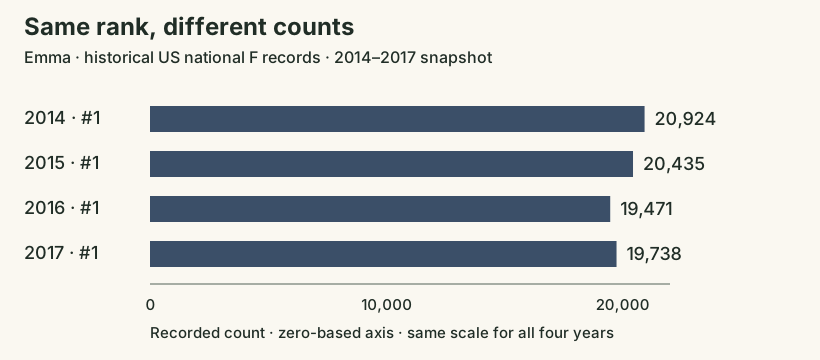
From 2014 to 2017, the count changed by -1,186: 19,738 minus 20,924. Divide that difference by the starting count and multiply by 100: −1,186 ÷ 20,924 × 100 ≈ −5.7%.
“First in both years” therefore hides a decline of about 5.7% across this interval. It also hides the intervening pattern: the count rose from 19,471 in 2016 to 19,738 in 2017. The four rows do not describe a steady annual decline, and they do not forecast a later year.
Use this sequence for your own candidate: compare the same spelling, geography and category across several years; record the counts; then examine the ranks. If a table has ties, keep its ranking convention rather than silently imposing a different one.
Count change and percentage share answer different questions
The −5.7% calculation above is a change in count between two years. Its denominator is Emma’s 2014 count. It is not the percentage of all babies called Emma.
A name’s share requires a different denominator: the relevant total for the same year, geography and category. The babynames documentation explains its separate proportion field using the total applicants in the relevant year and sex category. Do not mix an application-based name count with an unrelated live-birth total, a different year or both categories combined and call the result the same statistic.
When a source gives a proportion, read its definition before converting it to a percentage. Multiplying by 100 changes the display, not the population being described. If you cannot identify the denominator, leave the share unresolved and use the verified count with its scope.
Even a well-defined national share cannot tell you how many children with that name will be in one future classroom. Local naming patterns, the class’s age cohort and the actual group are different questions. Use national statistics as context, then treat what you hear among relatives, neighbors or a school as a separate, limited observation.
National, state and territory data are separate lookup choices
| Dataset | Catalog start year | What to keep with the result |
|---|---|---|
| National | 1880 | Birth year, spelling, recorded sex category and national scope. |
| State and District of Columbia | 1910 | The selected state or DC, birth year, spelling and category; national data is a separate dataset. |
| Territory | 1998 | The relevant territory resource and its actual coverage notes, birth year, spelling and category. |
Those start years come from the official catalog descriptions. They do not supply a result for a particular state, territory, city or school. If you are checking one area, open that resource and read the relevant rows.
Do not combine a state rank with a national count in one unlabeled comparison. Keep separate records if both views matter to your family. A name can have a different position in a state list without either list being wrong; the groups being ranked are different.
Likewise, do not assume that adding every displayed state count reproduces a displayed national total without checking the file’s inclusion rules and coverage. The useful next step is to identify the source and its boundaries, not to force two differently scoped tables to agree.
Real example: combining spellings changes the unit
The archived 2017 F-category rows distinguish Sophia and Sofia. Their counts and reconstructed positions are:
| Exact spelling | Recorded count | Position reconstructed by count |
|---|---|---|
| Sophia | 14,831 | 5 |
| Sofia | 8,134 | 15 |
Adding these two rows gives 22,965. That is a calculation for a group you created. It does not turn either individual spelling into the first-ranked name, even though the sum is larger than the archived Emma count of 19,738.
A combined-spelling comparison may answer your own question about names that sound similar in your pronunciation. Label it as a custom group, state which spellings and categories you included, and keep the original rows available. It is not the official rank of either spelling and does not prove that every family pronounces them identically.
For a personal choice, you might care both about the exact spelling on forms and about names that sound similar when called aloud. Those are two legitimate questions with different units. Do not let a convenient combined total blur that distinction.
A missing name is not automatically an unused name
A top-100 or top-1,000 display is a limited list. If your candidate is absent, first check whether it falls outside that display’s cutoff. Absence from a short ranking does not supply a count of zero.
The CRAN package description and manual state that its reproduced data include names with at least five uses. A missing row in this historical package therefore cannot establish that nobody used the name. Keep that limit with any conclusion drawn from the package.
Also check the exact spelling, year, geographic file and recorded category before calling a result missing. A typo or a comparison between different categories can look like an unusually rare name while answering a different question.
If a site simply labels a name “top 10,” “familiar” or “rare” without a year and source, treat that as an incomplete popularity statement. Ask which table and date support it before comparing the label with another candidate’s numeric rank.
Use the statistics to clarify a preference, not decide for you
Write what you want the popularity check to do. You may welcome familiar spelling, prefer fewer names that sound alike in your immediate circle, or simply want to understand a trend before making a choice. A count cannot decide which of those preferences matters most.
After checking the data, try the complete name with your intended surname and familiar spoken forms. Record a concrete benefit you like and a practical concern you still need to resolve. Keep this exercise separate from the statistical lookup so a rank does not become a substitute for the name you actually intend to use.
If two family members read the same rank differently, compare the underlying preference. One may see familiarity as helpful; another may want distinction. The statistic can describe its own list, but it does not turn either preference into a factual rule.
Keep a comparison record with its source and scope
Download the editable statistics comparison record. Fill it for one exact spelling and one clearly identified geographic/category comparison.
Exact name: Emma
Source: babynames 1.0.1, a historical reproduction of SSA data
Geography and recorded category: US national, F
Birth years: 2014 and 2017
Counts: 20,924 and 19,738
Position by count: unique highest count in both years
Count change across the interval: −1,186, approximately −5.7%
Latest-year count and local classroom frequency: not established by this example
When you return to the record, you should be able to reconstruct the calculation and see which questions remain unanswered. That is more dependable than remembering that a name “went up” or “was number one” without the count, year and dataset.
Three checks before trusting a popularity claim
These original practice questions use the historical rows and the scope rules above. The explanations identify what the statistic can establish.
Case 1
Emma has the highest count in the national F category in both 2014 and 2017. Does that prove its recorded count stayed the same?
Show answer and explanation for case 1
No. The archived counts are 20,924 and 19,738.
The rank describes relative position within each year. Its count fell by 1,186 across the interval even though its position stayed first.
Case 2
You add Sophia and Sofia’s archived 2017 F-category counts. Can you label the sum as Sofia’s official individual rank?
Show answer and explanation for case 2
No. It is a custom two-spelling group.
Adding 14,831 and 8,134 gives 22,965, but the calculation changes the unit. Keep both original rows and label the aggregation.
Case 3
A page updated in 2026 shows data for births in 2025. Is that a 2026 birth ranking, and can an absent name be given zero uses automatically?
Show answer and explanation for case 3
No to both claims.
The birth year controls the annual comparison. A missing row may reflect a list cutoff, the historical package’s inclusion threshold, or a different spelling, area or category.
Sources and further reading
- SSA on Data.gov: National baby-name datasetOfficial publisher, application-based name/year/sex/number fields, start year 1880, annual metadata and resource links. Catalog metadata checked October 30, 2026.
- SSA on Data.gov: State and District of Columbia datasetOfficial state/DC scope, additional state field and start year 1910. No state counts invented or inferred from the national examples.
- SSA on Data.gov: Territory datasetSeparate territory resource and start year 1998; consult its actual coverage for a particular area.
- CRAN: babynames version 1.0.1Named historical SSA-data reproduction covering 1880–2017, published April 12, 2021, with a minimum-use inclusion limit. Source package obtained and hashed; worked counts extracted from its data file.
- babynames reference manualApplication-based data, five-use inclusion limit, name/year/sex/count fields and the separately defined proportion field.