Practical guide
A Baby Name Pronunciation Guide for Families
Keep the complete written name, the spoken form, its language version and a matching demonstration together. Use a plain stress cue only where it helps, label regional or family differences, and record both ordinary speech and a short example sentence. This original card template, recording worksheet and six cases help a listener repeat the intended version without turning spelling or a dictionary entry into a universal rule.
Start with the version your family intends to use
Before writing a pronunciation guide, say the name as you want it used. Decide whether you are explaining the complete name, the everyday given name or a separate familiar short form. Write the complete spelling alongside that choice so a listener can connect the spoken model with the right written form.
The useful question is “How do we communicate this intended version?” A dictionary entry, a name’s origin and a family recording answer different questions. A dictionary can supply a reference pronunciation for a particular language or variety; a recording can demonstrate what this family intends. Neither proves a name’s popularity or meaning.
Start with a small audience: a relative, caregiver or person who will make an introduction. Ask what they need to say and what written form they will see. A guide for addressing a child every day may differ from a guide for reading the complete name at an event.
Do not reduce a complete name to a first-name/last-name model just to fit a card. W3C’s personal-name guidance describes differing name orders, multiple parts and ambiguity between written forms and pronunciation. Keep the actual name and order, then explain the relevant spoken form.
Keep six useful fields on the same card
| Field | Record | Avoid |
|---|---|---|
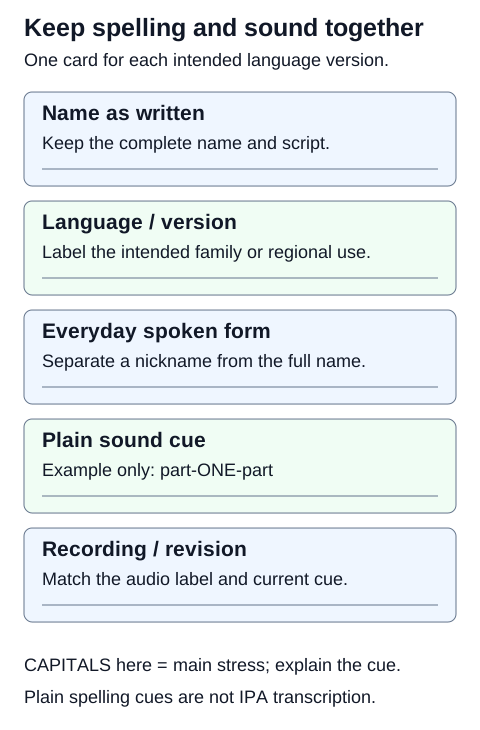
| Name as written | Keep the complete spelling, script, spaces and punctuation. | Do not replace this field with a sound cue. |
| Version and language | Label the language and, when relevant, the regional or family usage. | Give different intended versions separate cards. |
| Everyday spoken form | Record the actual form used to address the child. | Keep any nickname separate from the full name. |
| Plain sound cue | Write a listener-friendly approximation and explain its convention. | An English cue can leave vowels or consonants unclear. |
| Stress or other sound notes | Mark the main stress if that description fits the language. | Use appropriate speaker help for tone or other distinctions. |
| Recording and revision | Note the matching local recording and when you last checked it. | Do not point a new card to an old pronunciation version. |
Leave a field blank if you do not yet know how to describe it accurately. “Needs a speaker check” is more useful than guessing an IPA transcription or filling in a language label from appearance. When a knowledgeable speaker checks the model, update the notes and recording together.
The original pronunciation-card SVG gives a simple layout. Its artificial cue “part-ONE-part” shows how this card uses capitals; it is not an actual name, an origin claim or a phonetic transcription.
Write a stress cue that a listener can understand
For a language and version where stress is a useful description, break a plain cue into pronounceable chunks and explain which chunk is strongest. On this worksheet, CAPITALS mark the main stress. The artificial example “part-ONE-part” places that emphasis in the middle. Hyphens organise the cue; they do not change the name’s official spelling.
Say the cue aloud with the listener before relying on it. Ordinary English spelling can be ambiguous: a vowel example may sound different in different accents, or a consonant may be interpreted differently. Add a demonstration when the written approximation does not carry the sound clearly. Do not assume the listener ignored the guide when the cue itself was unclear.
Use capitals sparingly and state what they mean. They might otherwise look like a spelling instruction or a direction to shout. A stress mark describes relative emphasis in that version; it does not rate a name’s attractiveness or say how every language should pronounce it.
Some names need details that a simple stress cue cannot represent. Tone, vowel distinctions and other language-specific features may need a suitable description from a knowledgeable speaker. Keep the recording and language context rather than forcing every name into an English-looking cue.
Keep plain cues separate from dictionary pronunciation symbols
The Cambridge Dictionary pronunciation-symbols guide uses the International Phonetic Alphabet (IPA), with transcriptions shown between slashes. It explains that ˈ marks primary stress and ˌ marks secondary stress. The stress symbol comes before the syllable it marks. A dot separates syllables in its main convention.
Cambridge also notes differences between its dictionary conventions: some American dictionary entries use a raised dot for division and omit certain vowel-length markers. Check the actual source’s legend before copying a symbol. A raised mark is not automatically punctuation belonging in the written name.
Our capital-letter sound cue is a different, informal method. Do not put an approximate English respelling between IPA slashes and present it as a precise transcription. If you include IPA, use a suitable source or a checked transcription and keep its language/version label.
The same help page places UK and US sounds alongside one another and notes that some sounds occur in only one of those varieties. This shows why a pronunciation source needs a variety label. It does not show that every personal name has exactly two versions or that its pronunciation can be inferred from the country where a child lives.
Give different intended versions their own labels
If your family uses more than one version, make a separate card or clearly separated entry for each. Write the same complete spelling where appropriate, then give the language, the spoken form and its matching recording. Add a regional description only when it is relevant and you can explain what it refers to.
Do not combine a vowel from one version and a stress pattern from another unless that combination is actually the family’s intended model. A shared spelling can conceal different spoken forms. A transliteration can also lose distinctions present in the original script; it is not an automatic pronunciation key.
For example, an original worksheet can label “Version A — used in this family’s English introductions” and “Version B — used in another language at home.” Those are context labels, not claims about everyone who speaks the language. Ask an appropriate speaker to check each model independently.
Keep name order and address preferences visible too. The complete written name and the form someone should use in a greeting need not be identical. If a receiving organisation’s form cannot retain the name correctly, ask about its requirements instead of silently deleting a component. This worksheet does not determine registration rules.
Record a short, useful spoken model
Use a recording method already available to you and make a short demonstration in a quiet place. A family member can model the pronunciation; a child’s voice is not necessary for this worksheet. The instructions below are an original communication method, not a review of a particular app or device.
- Say the intended name once at an ordinary speaking pace.
- If useful, say the components or difficult part more slowly without turning the whole model into exaggerated speech.
- Say the name in a short natural sentence, such as “This is [name].”
- Listen back and check that the beginning, ending and relevant sound distinctions are audible.
- Give the recording the same language/version label as the written card, then test whether a listener can repeat the intended form.
The ordinary-speed take is the main model. A slow take can help locate a sound, but it should support the normal version rather than replace it. If a full name and a short form are both needed, record each and explain when to use them.
Keep the recording and card somewhere you can find them together. Share only what the intended listener needs; the card has no need for a birth date, address or other unrelated family details. The downloadable worksheet requires no submission of your name or audio to this website.
Check the instruction before repeating it
| What happens | Check | Next step |
|---|---|---|
| Two people hear a cue differently | The cue’s vowel examples and the listener’s accent. | Add a matching recording or a more precise speaker-approved note. |
| The written cue has one strong syllable | Whether CAPITALS were intended to mark main stress. | Explain the convention instead of asking the reader to guess. |
| A dictionary gives another pronunciation | The dictionary’s language, variety and actual entry. | Label the reference and the family version separately. |
| Two languages use different versions | The context and the name order in each version. | Keep two labeled cards and matching recordings. |
| A form has too few name boxes | What the receiving organisation actually requires. | Ask how to retain the full name; do not delete a part automatically. |
| A listener repeats an older version | The cue, recording and revision label they received. | Send the current intended version and retire a misleading old card. |
Ask “What did you hear?” before giving a longer explanation. That can expose an ambiguous cue, an unclear recording or a mismatch between the full name and the short form. Demonstrate the intended model, invite a repeat and revise the part that caused confusion.
A useful correction is brief: “We use this version: [demonstration]. The emphasis is here: [cue].” The listener does not need an invented linguistic rule or a judgment about another accent. Keep the instruction connected to the actual form you want used.
Recheck the card whenever its cue, preferred spoken form or audience changes. A revision label helps keep the text and recording consistent. A small family listening check is useful feedback; it is not a study of how every future teacher or stranger will respond.
Practice six pronunciation-card decisions
These invented situations test whether the written and spoken models stay clear. They are not recordings of real children or evidence that a particular name will cause difficulty.
Case 1
Two grandparents read the same written sound cue with different vowels. Has one of them necessarily ignored the instructions?
Show answer and explanation for case 1
No. Check what the cue actually communicates to each listener.
A cue built from ordinary English spelling is an approximation. Its example vowels can be heard differently across accents, and the listener may not know which syllable the capitals are meant to emphasize. Ask each person what they heard, without first calling the response wrong. Then demonstrate the intended version, add a matching recording if useful, and revise the ambiguous cue. The goal is a repeatable family instruction, not winning an argument about a spelling convention.
Case 2
A family wants to use one pronunciation in one language and another in a second language. Should the card combine pieces of both into a single compromise?
Show answer and explanation for case 2
Keep the intended versions distinct and label when each is used.
A merged cue can leave the listener with a pronunciation nobody intended. Write separate version labels, complete written names and sound notes, and keep a matching recording for each. If the name order changes in an introduction, show that order clearly as well. Ask the relevant speakers to check each version on its own. The presence of two versions is not proof that one must be corrected or that the name has two different origins; those are separate questions requiring their own evidence.
Case 3
An English dictionary pronunciation differs from the family’s chosen spoken form. Does the dictionary entry settle how this particular child must be addressed?
Show answer and explanation for case 3
Use the entry as a labeled reference and communicate the intended personal pronunciation.
First check that the source covers the exact spelling and language you are asking about. A dictionary describes its selected pronunciation or variants; it does not record every individual family’s intended use. Keep the family’s demonstrated version on the communication card. If the family wants to understand a traditional language form, ask a knowledgeable speaker or consult an appropriate source separately. Neither a sound cue nor a personal recording proves an etymology, regional prevalence or official registration rule.
Case 4
The recording says only a familiar short form, while the printed card shows a longer full name. Is that enough for someone who needs to introduce the full name?
Show answer and explanation for case 4
Record the full form too, and explain the role of the short form.
A listener cannot reliably reconstruct an unrecorded name from a nickname. Keep the complete written form, the everyday spoken form and any short form as distinct entries. Record the complete name in its intended order, then the short form if it is useful for that audience. Say which one should be used in the particular introduction. The name does not need an invented expansion, and an organisation’s form layout is not a reason to silently remove a family-name component.
Case 5
A very slow recording sounds clear, but a listener loses the name when it is spoken in a normal sentence. Should every future introduction use the exaggerated slow version?
Show answer and explanation for case 5
Add an ordinary-speed demonstration and a short natural sentence.
A careful component-by-component take can help someone locate a sound, but it may alter rhythm or hide the transitions in ordinary speech. Keep a normal spoken version as the main model. Use a slower take only as a supporting explanation, then return to the whole name in a simple introduction. Listen back to check that the microphone captured the beginning and ending, and invite a listener to repeat what they heard. That small check does not predict every future listener’s reaction.
Case 6
The family revises its pronunciation note after a speaker points out an ambiguity. The old recording is still attached to the card. Is changing only the printed cue sufficient?
Show answer and explanation for case 6
Update the cue, recording and version label together.
Conflicting instructions force the listener to choose between the written and spoken models. Check that the complete spelling, language label, everyday form, sound cue and recording describe the same intended version. Retain an earlier record separately only if the family needs it, and make clear that it is no longer the current instruction. Share the revised version with the people who use it. A date is a revision aid, not a claim that the card has undergone professional linguistic review.
Download the card and keep a clear revision
Download the blank pronunciation-card layout and the family pronunciation and recording worksheet. The worksheet includes two version records, the recording sequence, listener checks and all six case explanations.
Use one record for each intended version. Retain the complete name, the form used to address the child, the cue convention and the matching recording label. Before passing it on, check that someone can read the card and identify which model to follow.
For a different naming decision, use the short-name and surname rhythm guide to compare candidate combinations, or the broader naming checklist to consider the full decision. The pronunciation card is a communication aid for an intended version, not a score that chooses a name.
Sources and further reading
- Cambridge Dictionary: Pronunciation symbolsIPA versus ordinary letters; UK/US variety labels; primary and secondary stress; syllable division and differing dictionary conventions. Complete visible article read; no audio played or specific personal-name pronunciation adopted.
- W3C Internationalization: Personal names around the worldSelected introduction, name-part/order examples, written-form ambiguity and field-design guidance: preserve complete names and ask how a person should be addressed. Not a source of a specific child’s pronunciation or registration requirements.