
Content revised 2026-11-02 · Evidence and limits are stated below.
Choose the language question before choosing the list
A name-origin directory is most useful when it helps you ask a precise question. Are you looking for a name used in a particular language, a spelling that honors a relative, or a name formed from a particular root? Those are different searches. A name may be widely used in English while having a Hebrew history; another may be an English literary creation whose letters happen to match a name in Turkish. Start with the history or community that matters to your family, then examine the exact form.
Use the existing Latin, Greek, Hebrew and Irish lists as discovery routes. A catalogue tag is a browsing aid, and some entries still need more detailed language qualification. It is not proof that every name on a list has one settled root, one pronunciation or the same cultural use. This guide gives a separate, source-linked way to check a candidate before carrying a label into your family record.
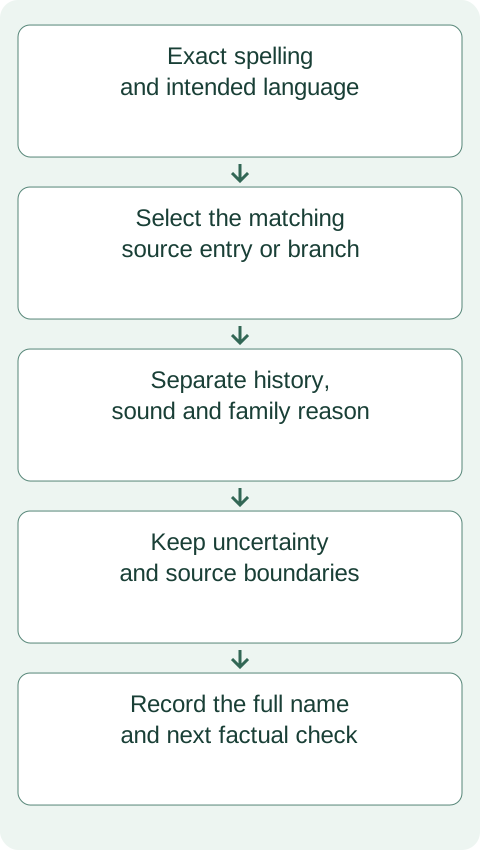
Write the candidate as you found it, including any diacritics or original-script form available in the source. Beside it, record the intended language and who uses that form in your family. If the only evidence is “it looks Latin” or “it ends like another Hebrew name,” leave the origin question open. Similar appearance is a reason to investigate, not an etymological method. A later style association can be valuable without becoming a historical root.
You can also start from a relative’s actual name. Keep the family connection separate from the dictionary explanation: the name may honor someone even when its history is uncertain. If you plan to adapt the spelling, check whether the adapted form is documented in the language you intend. A new spelling may be an original family choice; you do not need to assign it an ancient history to make that choice meaningful.
Separate usage, formation and deeper roots
| Question | What an answer can establish | What it cannot establish |
|---|---|---|
| Where is the name used? | A language or community in which a reference records the form. | That every user shares an ethnicity or that the form originated there. |
| How was this form made? | A short form, surname transfer, transcription, variant or literary creation. | That all similar spellings share that formation. |
| What older root is proposed? | A specific word or element, with uncertainty retained. | A prediction about the child’s character or a universal modern translation. |
| How will we say it? | The family’s intended pronunciation in a named language. | A syllable count that applies to every language version. |
Nora illustrates these levels. Behind the Name’s Nora (1) entry describes it as a short form of Honora or Eleanor in several European-language contexts. Honora and Eleanor are different historical paths. The Eleanor entry retains uncertainty about its derivation, so the short form does not inherit one certain literal meaning merely because several websites repeat an attractive translation. Nora (2), an Arabic transcription of Nura, is another entry. Nura is the feminine form of Nur, whose Arabic root means “light.”
A careful note can therefore say “Nora, Arabic transcription through Nura/Nur, connected with light” when that is the branch intended. It should not give every Nora the same light meaning. If you intend Nora as a short form of Honora, record that connection; if you intend the Eleanor branch, keep the uncertainty in the older history. The spelling alone cannot choose the family’s intended branch.
This distinction also prevents a common shortcut: moving a name into the language of its deepest known element and dropping the intervening formation. A name can have a documented development in one language through an older name from another. Record both levels when relevant. For a worked comparison of an Irish short form and a Hebrew biblical name, see the Liam and Noah evidence guide.
Ayla and Isla: a similar sound does not choose the history
| Exact source entry | History described | Pronunciation boundary |
|---|---|---|
| Ayla (2) | Turkish and Azerbaijani; moonlight or halo. | This entry does not supply an IPA pronunciation to copy. |
| Ayla (1) | Hebrew transcription through Ela (3), itself a modern form of Elah. | Listed Hebrew /e.ˈla/ has final-syllable stress. |
| Ayla (3) | English literary creation by Jean M. Auel for The Clan of the Cave Bear, 1980. | Listed English /ˈeɪ.lə/ has first-syllable stress. |
| Isla through Islay | Scottish/English form connected with the Scottish island Islay. | Listed English /ˈaɪ.lə/ has two syllables. |
For Ayla, choose the source entry rather than blending all three into a single “global meaning.” The Turkish/Azerbaijani entry gives moonlight or halo. The Hebrew-transcription entry follows a different name chain. The English literary entry identifies a modern creation. These histories can coexist because identical Latin letters do not necessarily represent one name. None of these facts establishes that your own family must choose one particular spelling or pronounce it like another language.
The Hebrew source chain read for this guide reaches Ela (3), which points to Elah. That identifies the connection, but this guide does not add a literal tree translation from an unread parent entry. Keep the source boundary visible. If that exact word history is central to your decision, continue to the matching parent entry and a suitable Hebrew reference before recording a translation. A narrow verified statement is more useful than a poetic sentence assembled from unrelated entries.
Isla is described as a variant of Islay, the name of a Scottish island. The listed English sound is approximately EYE-luh. Spanish also has the ordinary word isla meaning island, but the coincidence of letters does not make the documented Scottish name a Latin-origin name, or make the English and Spanish pronunciations identical. Ask which form and history you intend; do not select a pronunciation because a general catalogue assigned one origin tag.
Try a practical source check: write Ayla or Isla, the entry number, the relevant language, and the exact claim you want to retain. Then say the full name in the intended pronunciation. If the sound you like belongs to a different branch from the history you want to honor, record that tradeoff plainly. A family can make an informed choice without claiming that every branch is interchangeable.
Maya: keep three histories and language versions distinct
| Branch | What the entry supports | A claim to avoid |
|---|---|---|
| Maya (1), Sanskrit | Sanskrit māyā: illusion or magic; Indian-language and religious contexts. | This name predicts an imaginative personality or guarantees religious acceptance. |
| Maya (2), English | An English variant of Maia; the entry also discusses other associations. | Every Maya is a Sanskrit name or every Maya has one Greek-root meaning. |
| Maya (3), Hebrew | Hebrew form connected with mayim, water. | Inventing a Hebrew pronunciation from the English entry. |
| Maia (1) | Greek maia: good mother, dame or foster mother; deeper explanation qualified as possible. | Presenting every proposed deeper derivation as certain. |
The Sanskrit Maya entry gives illusion or magic in its stated linguistic context. That root-word explanation is different from a parent’s association with creativity or wonder. If a religious or cultural connection matters to you, ask people familiar with the intended tradition about the particular use. A dictionary entry identifies a history; it does not grant community approval or establish that every bearer shares the same belief.
The English Maya entry is connected with Maia. The Maia source describes a Greek word and retains a possible deeper explanation rather than treating it as fully settled. Its listed English pronunciations have two syllables, approximately MAY-uh or MY-uh. The same entry lists a Georgian form with a different, three-syllable pronunciation. This is a concrete reason to qualify a syllable count with a language and spoken form instead of printing one number as a universal fact.
The Hebrew Maya entry connects the name with water, but it does not list an IPA pronunciation in the material checked for this guide. Do not fill that gap by copying the English sound and calling it verified Hebrew. Record “pronunciation to confirm” and ask a speaker or consult an appropriate pronunciation source. Missing information is an actionable research question, not evidence that the intended form is unsuitable.
For a Maya candidate, your useful note might read “Hebrew branch; water connection; intended pronunciation still to confirm,” or “English form related to Maia; we intend MY-uh; Greek source explanation kept separate from our family association.” Both notes identify what was checked and what remains open. The similar-sounding names guide gives more practice with this kind of distinction.
Build a source record you can actually use
Save an entry title, exact URL and a short statement in your own words. Include the language or branch number when a dictionary uses multiple entries. Quote only the small wording needed to preserve a qualification such as “possibly” or “likely”; a long copied biography does not help your naming decision. If you consult a source’s references, distinguish the reference listed on the page from a book you have actually read.
Keep three separate lines: documented history, intended pronunciation, and family meaning. The first follows evidence; the second describes a spoken version you will use; the third explains why you care. You may honor a grandparent, enjoy a story or associate a name with a place. Those are valid personal reasons, but they should not be presented as literal translations. This separation lets you change a personal preference without silently changing a factual claim.
When sources disagree, first check whether they discuss the same spelling and language. A short form, a transcription and a surname transfer can look like conflicting explanations when they are actually different forms. If they discuss the same form but offer different derivations, retain the disagreement or mark the origin uncertain. Counting identical claims across unsourced lists is not a substitute for tracing where the claim came from.
Finally, test the intended name with the complete family name. Preserve all surname parts and the written form your family uses; W3C’s personal-name guidance explains why one rigid first/middle/last-name pattern cannot represent every culture. Use the family pronunciation card to record stress and language versions, and the printable shortlist to keep the evidence beside the candidates.
Try five explained checks
Decision check 1: A source calls Nora a short form of Eleanor, while another discusses Arabic Nora through Nura. Must one be wrong?
Not necessarily. Identify the exact branch and intended language; do not merge separate histories into one universal meaning.
Decision check 2: Can Isla be classified as Latin solely because Spanish isla means island?
No. The checked name entry follows Scottish Islay; a coincident word does not establish that name history.
Decision check 3: The English Maia entry lists two syllables. Can that number be assigned to every language form?
No. The checked entry also lists a different three-syllable Georgian form. Record the spoken version and language.
Decision check 4: Ayla (3) identifies an English literary creation. Does that verify the Hebrew Ayla branch?
No. The Hebrew transcription is a separate Ayla (1) entry through Ela (3).
Decision check 5: Your family associates a name with a beloved relative. Must that association be its literal root meaning?
No. Record the family reason separately from the documented history; both can matter without being identical.
Open the UTF-8 reference notes and explained checks. Save your own candidate record separately.
Sources and limits
- Ayla (1) — Hebrew transcription through Ela (3); listed Hebrew pronunciation.
- Ela (3) — Modern Hebrew form through Elah; the unread parent entry is not treated as a verified literal translation.
- Ayla (2) — Turkish/Azerbaijani moonlight or halo entry; no IPA copied from another branch.
- Ayla (3) — English literary creation and its listed English pronunciation.
- Isla — Scottish/English form through Islay and listed English pronunciation.
- Islay — Scottish island-name connection.
- Nora (1) — Short forms through Honora/Eleanor; language contexts.
- Honora — Honora branch; no unread Honoria detail added.
- Eleanor — Uncertainty retained in the derivation.
- Nora (2) — Arabic transcription through Nura.
- Nura — Feminine form of Nur.
- Nur — Arabic light root.
- Maya (1) — Sanskrit illusion/magic branch.
- Maya (2) — English variant through Maia.
- Maia (1) — Greek word explanation, qualified deeper proposal and language-specific pronunciations.
- Maya (3) — Hebrew water connection; no invented IPA.
- W3C: Personal names around the world — Naming-format diversity; not legal approval or an optimum family method.