Two names, two histories, one fair comparison
Liam vs Noah
Compare Liam and Noah by source-based origins, intended pronunciation, complete-name sound and historical US counts, then make a considered family choice.
Updated 2026-11-02.
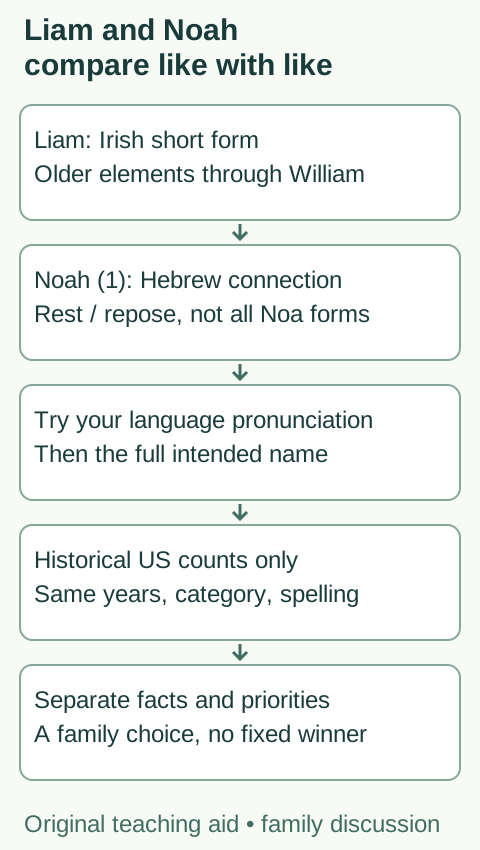
Liam and Noah have different histories, not one shared meaning
Liam and Noah may appeal to a family for their compact English sound, but their histories are different. Behind the Name describes Liam as an Irish short form of William. The William entry traces its Germanic antecedent Willehelm through elements meaning “will, desire” and “helmet, protection.” Those inherited elements explain a historical connection through William; they are not a literal modern sentence predicting the character of a child named Liam.
A careful Liam note therefore has two levels: the Irish short-form development, and the older elements inherited through William. Calling Liam simply a Germanic name omits the first level. Calling it literally “strong warrior” or using an attractive protector phrase without explaining the construction overstates what the source supplies. You can value an association with protection while describing it as an association, rather than as a guaranteed trait.
For the common masculine biblical Noah, Behind the Name’s Noah (1) entry gives a Hebrew connection with “rest, repose.” Keep that narrower claim separate from family associations such as comfort, renewal or calm. The source’s historical recorded usage category does not set a rule for who may choose the name or anyone’s gender identity. It identifies the particular name history being discussed here.
There is also a distinct feminine biblical Noah entry with a different Hebrew root. Similar English spelling does not merge the two histories. If your family intends that separate name or a Noa form, consult the matching source rather than transferring the rest/repose explanation automatically. The Noah guide explains this distinction. For this comparison, the selected history is the common masculine biblical Noah (1).
Compare the intended pronunciation, not a universal syllable formula
| Feature | Liam | Noah |
|---|---|---|
| History selected here | Irish short form of William | Common masculine biblical Noah (1), Hebrew rest/repose |
| Common English pronunciation | /ˈliː.əm/; approximately LEE-um | /ˈnoʊ.ə/; approximately NOH-uh |
| Common English rhythm | Two syllables, first-syllable stress | Two syllables, first-syllable stress |
| Important limit | The listed French /ljam/ differs from the English pattern | Other language versions need their own pronunciation check |
In the listed English pronunciations, both have two syllables and stress on the first. Liam begins with an L sound and has an M at the end; Noah begins with an N sound and ends in a vowel sound. Plain-language prompts such as LEE-um and NOH-uh are approximations for this English comparison. They do not reproduce every language’s sounds or replace a speaker’s guidance for a form important to your family.
Liam illustrates the language limit clearly: the source also lists French /ljam/, which does not have the same two-syllable pattern as the listed English pronunciation. The fact that a catalogue displays one English syllable count does not make it a rule for all uses. Write the language version you intend and try that version with the rest of the name.
If different relatives will use different language forms, record both. Ask which version the person is likely to hear in each context and whether your family is comfortable with that. A language-specific variation need not be treated as a mispronunciation simply because it differs from an English prompt. The pronunciation-note guide helps make an explicit family record.
Listen to each candidate with the complete name
Write the full intended combinations for Liam and Noah, including any known family or additional name parts in the order you expect to use. Do not compare one complete combination with the other first name alone. Naming structures vary, and not every family uses a fixed middle-name and surname arrangement. W3C’s personal-name discussion supports leaving room for that diversity when you record the candidates.
Say each combination as an introduction and at an ordinary calling pace. With Liam, listen around the final M and the beginning of the next component. With Noah, listen around the final vowel sound. What happens at those boundaries depends on the actual next sound and your intended pronunciation; a two-syllable count alone cannot determine the better combination.
You can try the same additional name with both candidates to isolate the first-name difference, then try another combination if your family is open to it. Note what you heard: clearer boundary, rhythm you prefer, repetition needed, or an intended honor name retained. These are observations from your own listening exercise, not measured results for every family. Do not invent an objective flow score for a choice that depends on pronunciation and preference.
Check initials if your family uses them, and try the everyday form as well as the formal complete name. A longer honor name may be a worthwhile tradeoff, even if one combination is less compact. Neither Liam nor Noah has to be defended as universally easier. Describe the particular combination you prefer and why; that explanation is more useful than applying an inflexible short-name-plus-long-surname rule.
Historical US popularity: Liam and Noah compared on the same basis
| Birth year | Liam: count, M | Liam: rank | Noah: count, M | Noah: rank |
|---|---|---|---|---|
| 2012 | 16,796 | 6 | 17,346 | 4 |
| 2013 | 18,131 | 3 | 18,241 | 1 |
| 2014 | 18,451 | 2 | 19,286 | 1 |
| 2015 | 18,355 | 2 | 19,613 | 1 |
| 2016 | 18,198 | 2 | 19,082 | 1 |
| 2017 | 18,728 | 1 | 18,326 | 2 |
These paired observations come from SSA application data reproduced in CRAN babynames version 1.0.1. The package covers birth years 1880–2017. The table above is a historical 2012–2017 example, not a current ranking, a forecast or a count for your local community. M is the dataset’s recorded sex category. The spellings Liam and Noah remain separate; Noa and related forms are not added to either count.
The displayed positions equal one plus the number of names with strictly larger counts in the same birth year and category. The selected rows have no equal-count ties. In 2012 Noah has 17,346 recorded uses at this count-based position 4, while Liam has 16,796 at position 6. In 2013–2016 Noah is at position 1 and Liam moves from 3 to 2. In 2017 Liam is at 1 and Noah at 2.
In 2017 the difference is 402 recorded uses: 18,728 for Liam and 18,326 for Noah. That difference does not establish a meaningful difference in your future classroom, or prove that Noah had become rare. Both occupy high positions in this particular historical national series. The source includes names with at least five uses; absence from a published rare-name row should not be interpreted automatically as zero use.
If current or local familiarity could change your decision, find comparable official evidence for both names and label its year, location, category and spelling. Do not mix a current ranking for one with this historical count for the other. The historical trend guide shows why counts and positions can change differently, while the SSA reading guide explains source limits and denominators.
Make the personal reason explicit for each name
A family considering Liam may value a William honor connection or an Irish short-form history. A family considering Noah may value the selected biblical connection, the English sound or a particular relative’s name. Those are possibilities to discuss, not assumptions about your family’s background. A linguistic source can explain a name; it cannot establish your ancestry or tell you why a particular relative was named.
Write a factual line and a preference line for each candidate. For Liam: “Irish short form of William, with the William source explaining older elements” belongs in the factual note. “We want a compact honor connection” belongs in the family note if that is actually your reason. For Noah: the selected rest/repose source history is factual; an association your family finds comforting is a separate personal reason.
If one person prefers the sound and another values the historical connection, discuss both priorities directly. Correcting an exaggerated literal meaning does not force you to discard a name you enjoy. It does mean that the final explanation should not depend on that exaggeration. You can say why you prefer Liam or Noah without promising protective, peaceful or otherwise predictable behavior from the child.
Avoid turning a preference into a claim about every other family. Neither a high historical rank nor a less familiar language form makes a name inferior. A personal association can matter strongly to you while remaining personal. Keeping the distinction visible helps you accept a tradeoff instead of trying to prove that the other candidate is objectively wrong.
Choose between Liam and Noah with the same checks
Start by completing the same record for both: exact intended written form, language pronunciation, complete-name sound, matching history source and any comparable usage evidence you care about. Mark an unanswered question as pending. If one candidate has a fully checked pronunciation and the other has only a catalogue assumption, resolve that difference before treating your preference as a finished comparison.
Use the two-finalist decision worksheet when the factual notes are ready. Each person can explain a priority, an observation and a compromise. For instance, one may prefer how Liam joins the next component, while another values the selected Noah history. The worksheet organizes the conversation; it does not calculate a universal winner or turn an unverified claim into evidence.
If the decision stalls, identify the missing step. You may need a language-specific pronunciation check, another complete-name trial, or a clear conversation about which family connection matters more. Additional popularity research will not necessarily resolve a disagreement about an honor name. More opinions will not settle an etymology question. Choose the next action that matches the actual uncertainty.
Before finalizing either option, verify the exact spelling you intend and any applicable registration requirement through the proper local source. Keep the factual history note and your family’s reason. This comparison supplies a source-based distinction and a dated historical example; your choice rests on the forms and priorities that matter in your own family.
Try five practical checks
Decision check 1: Is Liam’s Irish short-form history the same as William’s older Germanic elements?
They are different levels of the history. Liam is an Irish short form of William; William supplies the inherited will/desire and helmet/protection elements.
Decision check 2: Can Liam be described as two syllables in every language?
No. The listed English /ˈliː.əm/ is two syllables, while the listed French /ljam/ differs. Check the actual language form you intend.
Decision check 3: Does the rest/repose history apply automatically to every Noah or Noa form?
No. This comparison selects the common masculine biblical Noah (1). A distinct feminine biblical entry has another Hebrew root; consult the matching form.
Decision check 4: The 2017 table puts Liam 402 uses ahead of Noah. Does that predict your future classroom?
No. Those are historical US national application counts for exact spellings in the recorded M category. They do not establish current local probability or rarity.
Decision check 5: Which name wins if one person prefers the sound and another values a family connection?
The sources do not choose a universal winner. Record both priorities, try the actual complete names and discuss the tradeoff using the same factual checks.
Keep a useful record
Sources and limits
- W3C: Personal names around the world — Explains naming-format and character diversity in forms and data systems. It does not validate this family decision workflow or establish legal acceptance.
- Behind the Name: Liam — Supports the Irish short form of William and the listed English and French pronunciations.
- Behind the Name: William — Supports Willehelm and the will/desire and helmet/protection elements; not literal personality promises.
- Behind the Name: Noah (1) — Supports the selected common masculine biblical name, rest/repose history and listed English pronunciation.
- CRAN babynames reference manual — Describes the SSA application dataset, coverage through 2017 and the at-least-five-use threshold.
- CRAN babynames package record — Version 1.0.1 provides the historical archive used here; its publication date is not the birth year.
Family examples, diagrams and worksheet prompts are original teaching material. Name history, dated usage evidence and personal preference answer different questions. The workflow does not establish a universally best name, legal acceptance or a prediction about a child.