Noah: distinct roots and family use
Noah Name Meaning
Understand Noah’s Hebrew rest/repose root, its distinction from Noa, English pronunciation and pairing tests, with clearly dated historical US usage counts.
Updated 2026-11-02. Historical usage examples: US national birth years 2012–2017.
What the common Noah means: rest or repose
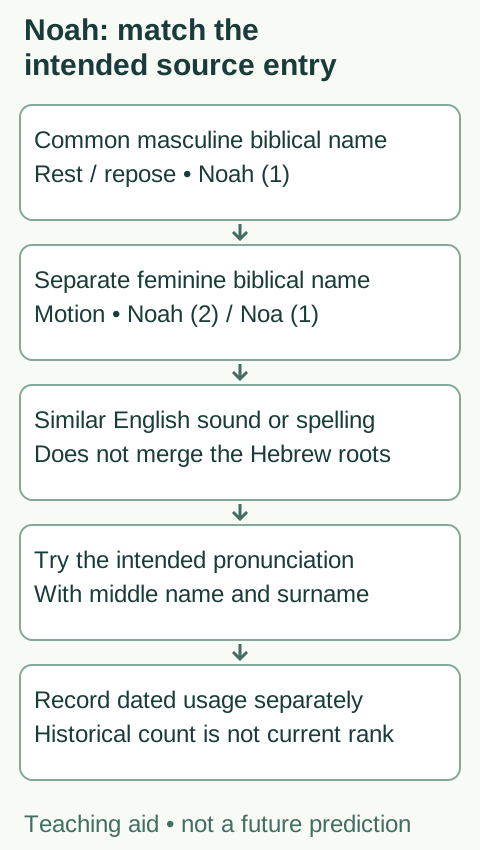
For the familiar masculine biblical name, Behind the Name traces Noah to Hebrew Noaḥ, with the meaning “rest, repose,” from the root represented as nuaḥ. This is the linguistic claim used in this profile. “Comfort,” “renewal” or “gentleness” may be meaningful personal associations, but they should not all be presented as exact translations of that root.
The biblical story of Noah and the ark is a religious and cultural association of the name. A family may value that story, the sound, a relative who bore the name, or a different personal connection. Describe the particular reason rather than treating the meaning as a promise that a child will be calm or that a name determines character.
A count table cannot verify the Hebrew derivation. The meaning and history source is separate from the US historical usage data below. Similarly, a short English spelling does not tell you everything about the original language, and a broad “biblical” label does not make all biblical names interchangeable. When a precise religious or language tradition matters, ask for guidance about that tradition rather than substituting a style tag.
Noah and Noa can represent different biblical names
There is another biblical name often written Noah in English, referring to a daughter of Zelophehad. Behind the Name treats this as a separate entry, derived from Hebrew Noʿa with the meaning “motion.” It identifies different Hebrew spellings from the masculine Noah name. The modern Hebrew feminine form is commonly represented as Noa in the source.
This creates an important distinction: the similar English sound or even the same English spelling can conceal separate histories. Do not automatically describe Noa as simply “Noah without the h,” or attach the masculine name’s rest/repose meaning to every use of Noa. Other languages also have forms and uses of these spellings, so the exact language and intended name matter.
| Question | Common masculine biblical Noah | The separate feminine biblical name |
|---|---|---|
| Source entry | Noah (1) | Noah (2), with Noa (1) as a related modern form |
| Root meaning in these entries | Rest, repose | Motion |
| What similarity does not prove | A shared sound does not merge the roots | A spelling variant must be checked in context |
If your family is considering Noa, or a feminine use of Noah, start with the relevant source entry and the language you intend. This profile focuses on the common masculine biblical name and does not assign one etymology to every bearer of the spelling. The language-origin guide gives a repeatable way to separate a related form from a similar-sounding independent name.
Pronounce the name you intend, then test full-name flow
A usual English pronunciation of the common Noah is NOH-uh, with two syllables and first-syllable stress. Behind the Name also lists a German pronunciation. English vowel guides are approximations, so use an actual spoken example for the language and accent your family intends rather than requiring every speaker to reproduce one written vowel description.
Try Noah with the middle name and surname in ordinary sentences. The short written form can still meet another vowel sound at a name boundary, and the whole combination may sound different from the first and middle names alone. Listen for clarity when introducing the person or calling the full name; do not assume two syllables automatically fit every surname.
Names that share an ending may be easy or difficult to distinguish in a particular family. Try sibling names both separately and together. If two are confused in ordinary use, another combination may work better for you. This is a family listening exercise, not evidence that similar endings are prohibited or that a specific sibling name has the same root.
A plain-language stress note and a short recording can help relatives who have not encountered the intended pronunciation. The pronunciation guide explains how to make the note. For an important Hebrew or other language connection, seek a speaker’s help with the particular form rather than treating an English transcription as the complete original pronunciation.
Noah’s historical popularity: a peak, then a different rank
| Birth year | US national M-category count | Count-based rank |
|---|---|---|
| 2012 | 17,346 | 4 |
| 2013 | 18,241 | 1 |
| 2014 | 19,286 | 1 |
| 2015 | 19,613 | 1 |
| 2016 | 19,082 | 1 |
| 2017 | 18,326 | 2 |
Noah moves from count-based position 4 in 2012 to 1 in 2013–2016 in this historical US national series. Its count reaches 19,613 in 2015, declines to 19,082 in 2016, and reaches 18,326 in 2017. In 2017 Liam has 18,728 uses in the same M-category data, placing Noah at position 2. A change from first to second is not evidence that the name became rare.
The source is the SSA application data reproduced in CRAN babynames version 1.0.1. That package covers birth years 1880–2017; its later publication date is not a new birth-year observation. M is the source’s recorded sex category, not a rule for anyone’s identity or name choice. The displayed ranks equal one plus the number of names with larger counts in that year and category, and the selected rows have no ties.
This table does not provide a current Noah rank, a state ranking, or the count for the spelling Noa. It also does not reveal whether an individual child’s name was inspired by a biblical figure, an actor, a relative or simply its sound. Those motives are not present in these count rows. Use the trend comparison to see how interval choice and other names affect a ranking, then check current official local evidence if it matters to your decision.
Middle names for Noah and alternatives worth comparing
Noah Elias, Noah Benjamin, Noah Wesley and Noah Cole are examples to try with your surname. They are suggestions for a sound comparison, not verified leading pairings or an objective ranking. Choose the intended pronunciation of each component and say the whole name at a natural pace before deciding which pattern you prefer.
A family honor name may matter more than making the full name as short as possible. Write the initials and think about the forms of the name your family commonly uses. If a middle name creates an awkward boundary in your intended pronunciation, try a different order or another candidate; a syllable formula alone cannot settle that question.
When comparing Noah with Liam, Ezra or another candidate, specify the feature you want to keep: brevity in English, a family connection, a biblical association or a particular sound. Similar appeal is not a shared etymology. Likewise, describing another name as “less common” requires comparable dated data for that name; this profile does not give a current rarity guarantee for its suggestions.
Noah is often used without a shortened form, but a family or the person may still develop nicknames. The final choice cannot promise control over every later form of address. Focus on the actual name and ordinary full-name use, then make space for the person’s preferences as they grow.
Keep the factual record and the family reason separate
A practical Noah note has four parts: the exact spelling and intended pronunciation, the source entry that matches the name you intend, any dated usage evidence you actually checked, and your family’s reason for liking it. For the common masculine biblical name, the source entry is the rest/repose one. If your intended name is the separate feminine biblical form, use that source history instead.
For example, “We like Noah’s English sound and a family connection. We are referring to the masculine biblical name linked with rest/repose. The historical US national M-category data shown here records 18,326 uses in 2017; that is not our current local count.” This avoids turning an old ranking or a poetic association into a broader factual claim.
Compare your other finalist by the same standards. Check its source independently, try its full-name pronunciation, and use matching dates and places if you want a popularity comparison. You can prefer a familiar name without defending it as rare, or value a cultural connection without pretending all communities use the same pronunciation.
Use the initials and surname checklist for the whole line, and the two-finalist worksheet for a shared discussion. Confirm any relevant registration requirements through the proper local source. The worksheet records your preferences; it does not establish religious approval, legal acceptance or a prediction about how the name will be received.
Check the claim before using it
Decision check 1: Does the common masculine biblical Noah have the same root as the feminine biblical Noa/Noah entry?
No. The consulted entries distinguish rest/repose from motion and different Hebrew names. Match the source to the exact language and intended name.
Decision check 2: Does removing an English h establish the meaning of every Noa?
No. A similar spelling or sound does not establish a shared history. Check the relevant source entry and language use.
Decision check 3: Does Noah’s rank of 2 in 2017 prove low familiarity now?
No. The table is historical US national M-category data and records 18,326 uses. It is not current or local evidence and does not define rarity.
Decision check 4: Can the count rows tell why parents chose Noah?
No. They contain year, category, spelling and count, not individual motives. A movie or family-tradition cause needs different evidence.
Decision check 5: Will a two-syllable English first name always fit a long surname?
No. Try the intended pronunciation of the full name. Sound boundaries, stress and family preferences matter beyond a syllable total.
Write your evidence and family note
Sources and limits
- Behind the Name: Noah (1) — Common masculine biblical rest/repose name and English pronunciation.
- Behind the Name: Noah (2) — Separate feminine biblical motion name and distinct Hebrew history.
- Behind the Name: Noa (1) — Modern form linked to the feminine biblical entry; not every same-sounding spelling.
- CRAN babynames 1.0.1 — Historical US national application counts ending in 2017.
- babynames reference manual — Fields and recorded category scope.
Popularity evidence and name history answer different questions. Historical package counts and reconstructed ranks are labeled by birth year, national coverage and recorded category. The name-history entries support the language claims described beside them. Pairing suggestions, diagrams and practice cases help apply those distinctions to a family choice.