Olivia: history and family use
Olivia Name Meaning
Explore Olivia’s olive-related history, English pronunciation and middle-name tests, with dated US usage counts and clear limits on meaning and popularity.
Updated 2026-11-02. Historical usage examples: US national birth years 2012–2017.
What Olivia means: an olive connection, with limits
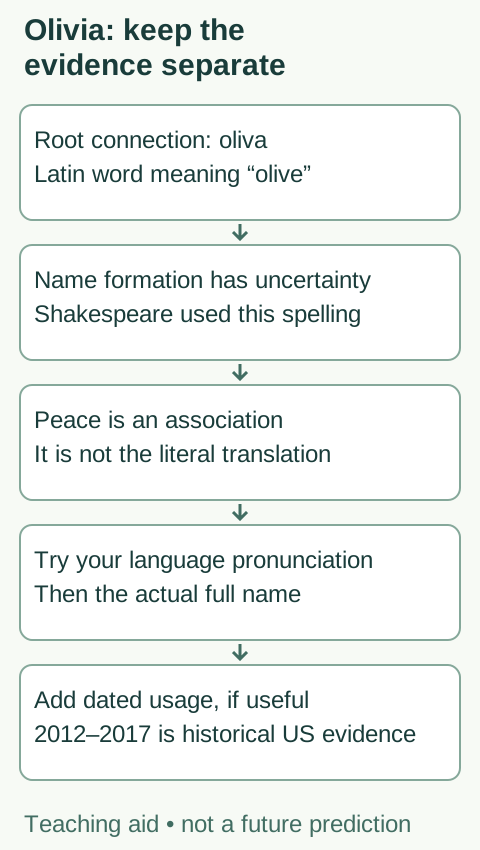
Olivia has an association with the Latin word oliva, meaning “olive.” Behind the Name discusses possible formation through Oliva or Oliver, or directly from the Latin word, and records uncertainty in that history. A careful summary is an olive-related name with a literary history, rather than a claim that every step of its creation is settled.
“Peace,” “calm” and “resilience” may be personal or cultural associations of olives and olive branches. They are not interchangeable with the word’s literal meaning, and they do not predict a child’s temperament. If the olive image matters to your family, you can explain it as an association you value while keeping the linguistic statement narrower.
Separate three questions in your note: what the root word means, how the given name developed, and what it means personally to you. A popularity table answers none of those origin questions. Nor does an attractive style label such as “romantic” provide linguistic evidence. The useful explanation should remain accurate even when the poetic description is removed.
Shakespeare used the spelling; do not assume he invented it
The name appears as Olivia in Shakespeare’s Twelfth Night. Behind the Name identifies that use and discusses Olivia as a rare name in Shakespeare’s time. This supports a literary connection, but it is a stronger and different claim to say the writer invented the name. This profile does not make that invention claim.
The historical source lists English and several other modern language uses, including Italian, Spanish and French. A Latin word connection and modern use in several languages are different kinds of information. It is reasonable to call Olivia Latin-related, while checking the pronunciation and use that matter in your own language community. One catalogue origin label cannot describe every family’s route to the name.
For family research, record the spelling found in an actual relative’s document and what you know about that person’s language or naming tradition. The word history can add context; it cannot establish your family’s ancestry. If a precise literary date, regional tradition or historical form matters, look for evidence for that specific question rather than treating a short name entry as a complete family history.
How to pronounce Olivia and try it with the whole name
An English pronunciation is oh-LIV-ee-uh, with stress on the second syllable and a four-syllable rhythm. Behind the Name also records an English form with an unstressed opening vowel. Its Italian and Spanish transcriptions have a different syllable pattern. The four-syllable English observation therefore should not be imposed as a universal rule for every language or accent.
Choose the pronunciation your family actually intends and say it with the middle name and surname. Try an ordinary introduction, a gentle call from another room, and a sentence such as “This is Olivia.” Listen for whether the boundaries remain clear. A longer first name does not automatically need a short middle name; the real combination is what you need to hear.
Record the main stress in plain language, and make a short spoken example for relatives who need one. Written vowel guides are approximate and can be read differently by different speakers. If another language is important in your household, ask a fluent speaker about that use before choosing a pronunciation solely from an English spelling guide. The family pronunciation guide helps create a practical note without labeling one community’s accent as an error.
Olivia’s dated popularity example: 2012–2017
| Birth year | US national F-category count | Count-based rank |
|---|---|---|
| 2012 | 17,310 | 4 |
| 2013 | 18,414 | 3 |
| 2014 | 19,791 | 2 |
| 2015 | 19,669 | 2 |
| 2016 | 19,327 | 2 |
| 2017 | 18,632 | 2 |
In this historical series, Olivia’s count rises from 17,310 in 2012 to 19,791 in 2014, then falls to 18,632 in 2017. It remains at count-based rank 2 in 2014, 2015, 2016 and 2017. This shows why a stable high position is not proof of increasing counts: rank compares one name with other names in the same year, while a count describes the recorded uses of that spelling.
These observations come from the US national SSA application data reproduced in the CRAN babynames package, version 1.0.1, whose coverage ends in 2017. F is the source’s recorded sex category, not an instruction about who may use the name. The displayed ranks are reconstructed from counts as one plus the number of strictly larger counts in the same category and year; these selected rows have no ties.
This is not a verified current “top ten” badge. If present-day familiarity matters to your choice, check the current official release for the relevant place and record its birth year. Do not assume that a national historical position predicts your local school, or that a differently spelled name shares Olivia’s count. The historical trend comparison explains the series and a changing top-ten group without inventing future ranks.
Middle names and nicknames: examples to test, not rankings
Olivia Mae, Olivia Rose, Olivia Claire and Olivia Juliet offer different sounds to try. They are original pairing suggestions, not measured popularity leaders or universally “best” combinations. Read each with the actual surname; a middle name that sounds clear beside Olivia alone can feel different once the full line is spoken.
A short middle can leave more space in a long full name, while a longer one may support a family honor name or another preference. Neither length is a correctness rule. Pay attention to repeated sounds at the boundaries, the initials you actually use, and whether each part remains recognizable when spoken at normal speed. If a family honor name is important, try that first instead of rejecting it simply because it adds syllables.
Behind the Name lists forms such as Liv, Livvy, Livy, Livia and Ollie as diminutives in English usage. These are possibilities, not a promise that you can control every nickname a child or their friends choose. Livia also has its own use as a given name, so sharing a nickname shape does not establish that every independently named Livia has Olivia’s complete history.
For sibling names or alternatives, choose the feature you want to keep: a literary association, a flowing sound, an olive-related image or a specific family connection. The alternatives by sound and style page offers suggestions without claiming that all have the same root or rarity. Do not call Sophia or any other alternative “quieter” without dated, comparable usage evidence.
A useful shortlist note for Olivia
Write the full name and the pronunciation you would use. Add one sentence about why Olivia matters to your family, one factual sentence about the olive connection, and one dated popularity observation if popularity is relevant. This produces a reasoned note that another person can understand without a pile of decorative labels.
For example: “We like the sound and literary association. The name is linked with Latin oliva, while peace is an association we personally value. In the historical US national F-category data shown here, Olivia has 18,632 uses in 2017; we have not yet checked current local use.” The family preference, word history and historical data stay separate.
Compare the note with another finalist using the same criteria. You might value a family name more than a shorter rhythm, or accept spelling corrections because a language connection matters. Those are personal decisions. Do not replace them with a generic score that treats a popular name as bad or an uncertain poetic claim as proven fact.
Before a final registration decision, confirm the exact spelling, intended pronunciation and any local requirements that apply to your family. The whole-name checklist handles initials and the surname, while the two-name worksheet keeps a shared conversation focused on your actual preferences. Neither tool supplies a cultural or legal approval for the name.
Check the claim before using it
Decision check 1: Can “peace” be reported as an exact translation of oliva?
Oliva means olive. Peace may be a symbolic association your family values; keep that separate from the literal root-word meaning.
Decision check 2: Does a Shakespeare character prove that Shakespeare invented Olivia?
No. The source supports his use of the spelling and discusses a rare name of that period. Use is different from invention.
Decision check 3: Is the four-syllable English rhythm a rule for Olivia in every language?
No. English and other-language pronunciations differ. Try the intended language form with the actual middle name and surname.
Decision check 4: Does the historical 2017 count supply a current top-ten claim?
No. It is a US national F-category observation from a package ending in 2017. Current or local usage requires a relevant dated release.
Decision check 5: Is Olivia Rose automatically better than Olivia Juliet because it is shorter?
No. These are comparison examples. Say both with the surname and weigh actual clarity, family meaning and preference rather than applying a length rule.
Write your evidence and family note
Sources and limits
- Behind the Name: Olivia — Olive-related formation, uncertainty, literary use, language-specific pronunciations and diminutives.
- CRAN babynames 1.0.1 — Historical US national usage data ending in 2017.
- babynames reference manual — Recorded categories, counts and application-based scope.
Popularity evidence and name history answer different questions. Historical package counts and reconstructed ranks are labeled by birth year, national coverage and recorded category. The name-history entries support the language claims described beside them. Pairing suggestions, diagrams and practice cases help apply those distinctions to a family choice.